



The warmest winter cycling sock is not the thickest one. A thick sock crammed into a shoe that already fits compresses the air layer that does the insulating and restricts circulation, so your feet end up colder than they would be in a mid-weight sock. This guide covers how to choose thickness, height and material for cold rides, and where socks stop being the right answer and overshoes take over.
Why a thicker sock often makes feet colder
Insulation is trapped still air, not fabric. A sock warms your foot by holding a layer of air against the skin. Squeeze that sock into a shoe with no spare room and you compress the air out of it, so you gain fabric and lose the insulation the fabric was there to hold.
The second effect is worse. A tight shoe presses on the top of the foot and reduces blood flow, and blood flow is what actually delivers heat to your toes. Cold feet in winter are far more often a circulation problem than an insulation problem, which is why loosening the shoe by one notch does more than adding a millimetre of wool.
The practical rule: your winter sock should be chosen at the same time as the space in your shoe. If your summer shoes fit snugly with a thin sock, a thicker sock needs either a looser buckle setting or a different shoe.
What thickness actually works
For most riders, a mid-weight sock with a slightly brushed or terry-looped interior is the right winter choice, worn in a shoe with a little room. Reserve genuinely thick socks for shoes you have sized up for winter, or for very low temperatures where you have accepted the trade-off.
Terry looping on the inside is the detail worth looking for. Small loops of yarn stand off the skin and hold air without adding much bulk, so you get insulation per millimetre that a flat knit cannot match. It also cushions the sole against road buzz on long cold rides. If you are starting from scratch, the general sock guide covers construction and fit before you get to season-specific choices.
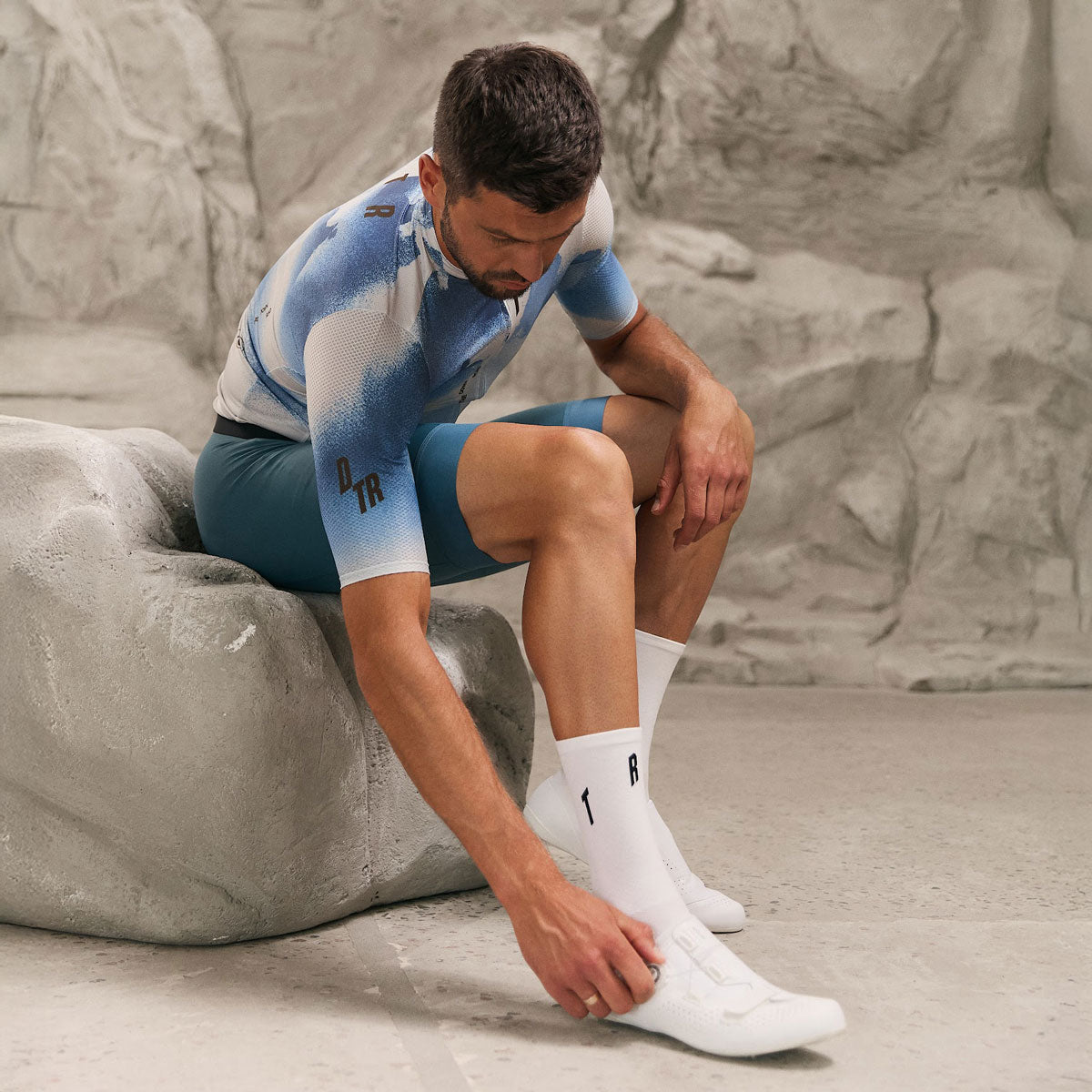
A useful test: with the sock on and the shoe closed to your normal setting, you should be able to wiggle your toes freely. If you cannot, you are trading warmth away, no matter what the sock is made of.
How high should they come?
Higher than summer socks, and specifically high enough to overlap whatever covers your legs. The gap between a sock cuff and the hem of bib tights or a leg warmer is a direct route for cold air onto the ankle, where blood vessels sit close to the surface.
A cuff sitting somewhere around mid-calf is the sensible winter default, which is taller than the ankle socks that work in summer and shorter than a full compression sock. If you ride in thermal bib tights with a stirrup or a long cuff, match the sock to sit under it rather than over it, so water runs outside the sock rather than into it. The same overlap logic applies to leg warmers on transitional days.
Height also matters for overshoe compatibility. A sock that stops below the overshoe cuff leaves a cold band; a sock that comes above it is warmer and stops the overshoe rubbing directly on skin.
Merino or synthetic for cold rides
Merino is the better cold-weather fibre for most riders, because it holds a reasonable amount of warmth when damp and resists odour over consecutive days. Synthetic dries faster, holds its shape and cuff tension longer, and costs less to replace. Most good winter socks blend the two for exactly that reason, and the same trade-off shows up in base layers.
What matters more than the fibre split is whether the sock manages moisture at all. Feet sweat in winter as much as in summer; the difference is that the moisture has nowhere to evaporate to inside a closed shoe. A sock that holds water against the skin is the single most common reason winter feet go numb.
Avoid cotton entirely. It absorbs several times its weight in water, holds it against the foot and takes hours to dry. In a winter shoe that is not a comfort problem, it is a cold problem.
Where socks stop and overshoes start
Below roughly 5°C, socks alone stop being enough on a road shoe, because the vents in the sole and the mesh in the upper are designed to move air. At that point the useful move is to block the airflow from outside rather than add insulation inside.
Taping over the sole vents costs nothing and makes a surprising difference on its own. Overshoes are the next step, and a windproof overshoe over a mid-weight sock will always beat a thick sock alone in a vented shoe.
Think of it as a system: sock for insulation and moisture, shoe for fit and space, overshoe for wind and water. Fix the layer that is failing rather than adding more of the one that is already working. The temperature guide sets out the same approach for the rest of the kit.
Wet feet are the real problem
Once a sock is soaked through, thickness stops helping. Water conducts heat away from the skin far faster than air, so a wet thick sock is colder than a dry thin one. That is why waterproofing at the ankle and overshoe cuff does more for winter comfort than anything you can do at the toe.
On genuinely wet rides, a waterproof sock is a legitimate option, but it only works if water cannot run down your leg into the cuff. Seal the top under a tight or a leg warmer, or the sock becomes a bucket.
For long rides in cold rain, a spare pair in a jersey pocket is worth the space. Ten minutes at a café with dry socks resets the whole second half of the ride. The DTR Tour sock packs small enough that carrying a spare costs nothing, and the rest of the range sits in the sock collection.
Common questions
Should I wear two pairs of socks? Only if your shoe has the room. Doubling up in a snug shoe compresses the insulation and restricts blood flow, which is the exact problem you are trying to solve.
Do compression socks keep feet warmer? Not directly. Graduated compression helps venous return, which some riders find helps with cold toes, but the sock is not doing any additional insulating.
What temperature needs a thermal sock? Around 8°C a mid-weight sock is usually enough. Below 5°C, add overshoes rather than thickness. Below freezing, look at shoe fit and winter boots.
How should winter socks be washed? Cold, inside out, no fabric softener. Softener coats the fibres and reduces both the loft and the moisture transport, which is most of what you paid for.
Do sock height rules still apply in winter? Racing conventions about cuff height, and the case for aero socks, are a summer conversation. In winter, choose the height that closes the gap to your leg covering.
See the cycling sock range at /collections/cycling-socks.
DTR — performance cycling and triathlon apparel, designed and developed in Ukraine.

Leave a comment
This site is protected by hCaptcha and the hCaptcha Privacy Policy and Terms of Service apply.