

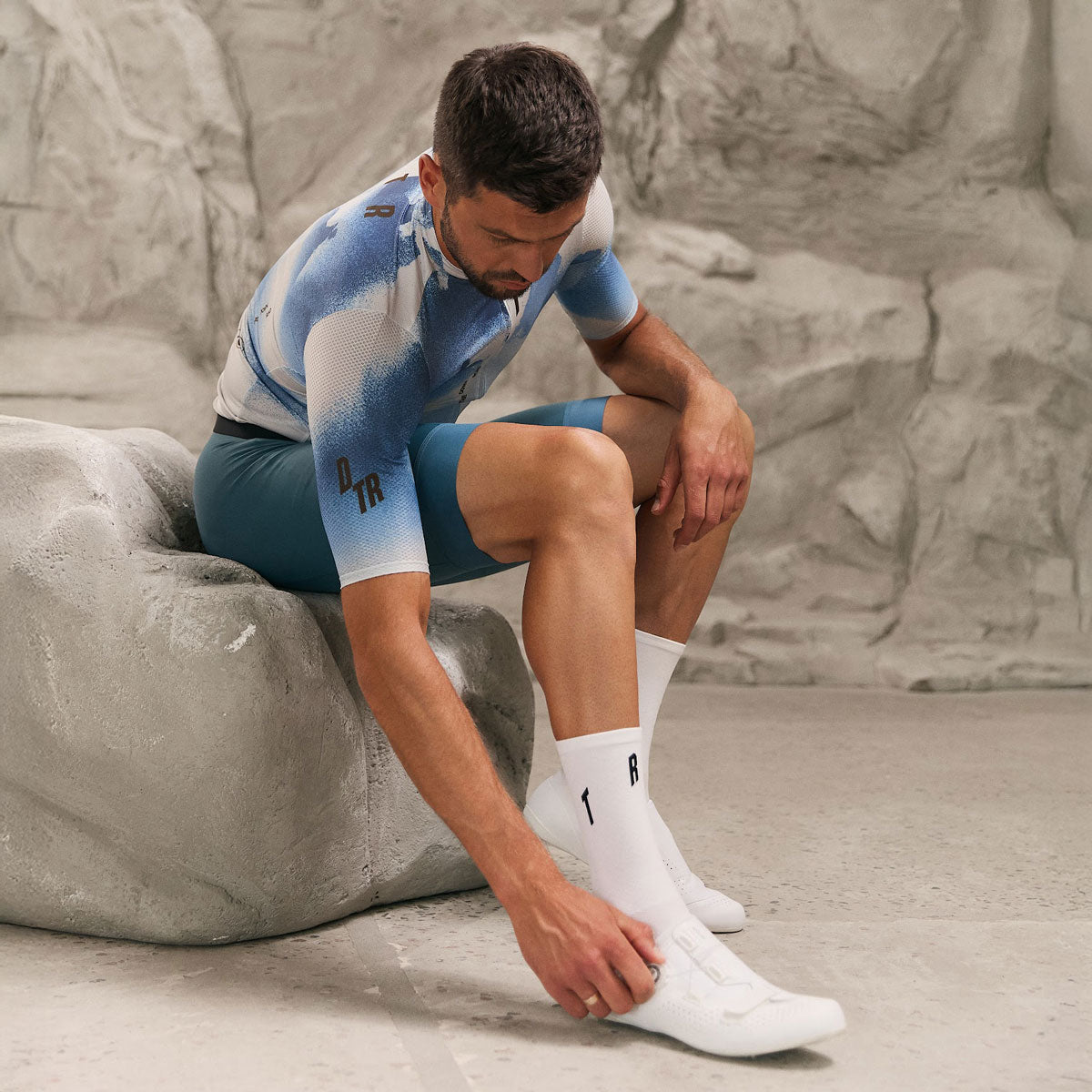
Compression socks apply graduated pressure to the lower leg — firmest at the ankle, easing as they rise toward the knee — to support blood returning up the leg against gravity. For cyclists, the effect that holds up most consistently is in how the legs feel after a hard ride, not in the power you produce during it.
This guide covers what that pressure does, when compression helps and when it does not, how to judge fit, what race rules allow on sock height, and when a well-built technical sock is the better choice.
How graduated pressure works
Graduated compression means the sock is knitted to squeeze hardest at the ankle and progressively less up the calf. That gradient supports the veins and the calf muscle pump that push blood back toward the heart — the part of your circulation working hardest against gravity while you sit upright on a bike.
The word that matters is graduated. A sock that grips evenly along its whole length, or bites hardest at the top cuff, is not doing the same job. Sports compression sits in a mild-to-moderate pressure range, well below the medical-grade levels prescribed for circulatory conditions.
Does wearing them on the bike make you faster?
No. There is no reliable evidence that compression socks raise power output or lower the oxygen cost of riding. Riders who train in them generally report less calf fatigue and less end-of-ride heaviness — a comfort effect rather than a performance one. Buy them for how your legs feel, not for watts.
Worth knowing: a full-length sock adds insulation around the calf. In summer that works against you. In cold and wet conditions it can be a genuine advantage, which is why you see them more often in autumn and winter racing than in July.
Where they earn their place: after you get off
Recovery is the stronger case. Wearing graduated socks for a few hours after a long or hard ride commonly reduces the heavy, swollen feeling in the calves, and riders report legs that feel fresher for the next day. The mechanism — helping fluid move out of the lower leg while you are sedentary — is the same one that makes them useful on long flights.
The scenario where this matters most is travel to a race. Hours in a car or on a plane after a hard session, or the day before an event, is exactly when the lower leg pools fluid and stiffens.
How tight should they feel?
Firm and even, never pinching. You want consistent support around the whole calf, with a cuff you can slide a finger under without effort. If the top band leaves a deep indentation, digs in behind the knee, or your foot tingles or goes numb, the sock is too small or the wrong shape for your leg.
Size by calf circumference as well as shoe size — calf shape varies far more between riders than foot length does, and a sock sized only on shoe size will be wrong on a lot of legs. Pull them on before the leg has warmed and swollen, not after.
Swelling that does not settle, numbness, skin discolouration or persistent leg pain are reasons to speak to a doctor rather than to try a different sock.
What the rules say about sock height
In UCI-regulated road racing, socks must not rise above the midpoint between the ankle and the knee. Full-length compression socks finishing just below the knee fall outside that limit, so they are not legal in those events — though they remain unrestricted for training, sportives and most amateur racing.
Triathlon is different. Compression socks are permitted in the bike and run legs of most triathlon events, including long-distance racing, and plenty of athletes use them from T1 onward. Always check the rules for the specific event.
When a standard cycling sock is the better call
For most riding — anything up to a few hours, in normal temperatures — a well-made technical cycling sock is the better tool. It is lighter, dries faster, breathes more freely and puts less heat around the calf, and a good one holds its shape in the shoe without needing compression to do it.
A simple way to split them: technical socks for riding, compression socks for the hours afterwards and for travel. Riders who race in cold, wet conditions or who spend long periods seated after training are the ones who get the most from owning both.
Frequently asked questions
Should I sleep in compression socks?
Most guidance advises against overnight wear unless a doctor has recommended it. Lying flat already removes the gravity problem the socks are designed to counter, and an ill-fitting sock worn for eight hours is more likely to cause problems than solve them.
How long should I wear them after a ride?
One to three hours covers most of the reported benefit. Longer is not obviously better, and the socks should come off before the skin gets damp and irritated.
Can I wear compression socks in a road race?
Not in UCI-regulated events, where sock height is capped at the midpoint between ankle and knee. Amateur races run under other rules often allow them — check the race manual.
Do they prevent cramp?
There is no good evidence that they do. Cramp has several causes, and compression is not a reliable answer to any of them.
Compression socks or compression tights for recovery?
Socks target the calves and ankles, where fluid pools most after riding. Tights cover more of the leg but are hotter and less practical to keep on for a few hours after a ride.
Browse the DTR sock range at /collections/cycling-socks.
DTR — performance cycling and triathlon apparel, designed and developed in Ukraine.

Leave a comment
This site is protected by hCaptcha and the hCaptcha Privacy Policy and Terms of Service apply.