



Cycling socks are thin, snug and quick-drying because they have to work inside a stiff, close-fitting shoe — cushioning bulk ruins the fit, and cotton holds sweat against your skin until it blisters. This guide covers what separates a cycling sock from a drawer sock, how tall to wear them, summer versus winter weights, when aero socks earn their place, and how to make a pair last seasons rather than months.
What makes a sock cycling-specific
A cycling sock is built for a rigid shoe and a fixed pedalling motion: a thin, even profile so the shoe fits the way it was designed to, technical fibres that move sweat off the skin, light hold through the midfoot so nothing bunches under load, and a flat toe seam that disappears inside the shoe.
Running socks solve a different problem. Running is impact, so running socks pad the heel and forefoot. On a bike there is no impact — pressure is constant and spread across the sole — so padding just eats volume inside a shoe that was cut for a thin sock. Add cotton's habit of soaking up sweat and staying wet, and a general-purpose sock turns a four-hour ride into a foot-care exercise. Quick-dry knit and a precise fit are the whole job description.
How tall should they be?
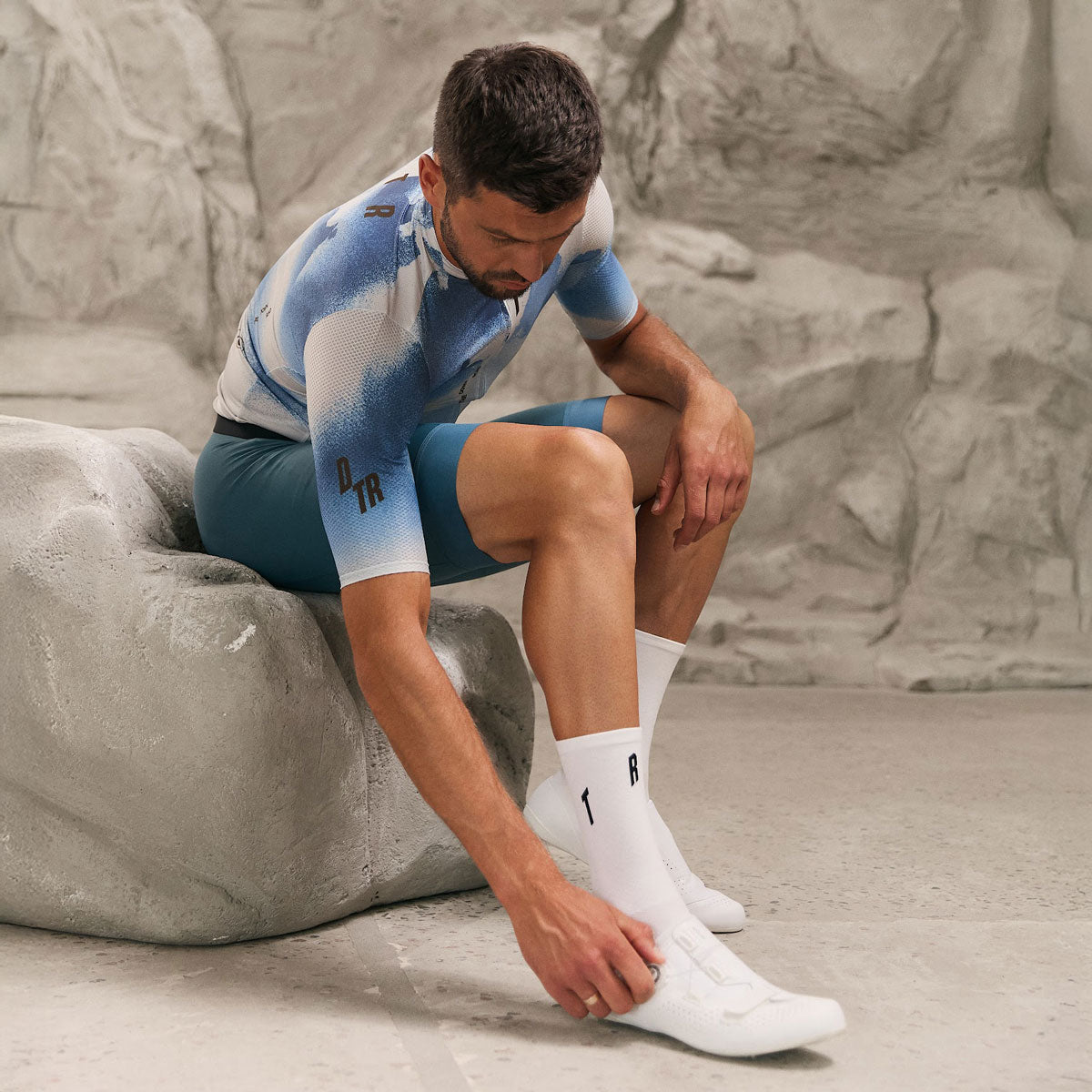
Tall enough to clear the ankle bone — and in practice, road convention has settled on a crew cuff that finishes around mid-calf. Height is mostly convention and comfort rather than performance, with one exception: aero socks, where the taller textured cuff does real work.
Beyond that, it's personal. Shorter cuffs are common on gravel and commutes; taller cuffs pair better with leg warmers in cold weather because the overlap keeps skin covered. If you ride in a group, you already know the unwritten rule — mid-calf reads right. Nobody's watts change either way.
Summer weight or winter weight?
Summer socks are thin, with ventilated mesh zones over the forefoot and a quick-dry knit that sheds sweat and road spray. Winter socks use a denser thermal knit — often with merino in the blend — that keeps some insulating value even when damp. The constraint is always the shoe: if a thicker sock makes it tight, you lose, not gain, warmth.
That last point catches a lot of riders. A cycling shoe holds your foot precisely; stuff a hiking-weight sock into it and you compress the foot, restrict circulation, and end up colder than you were in the summer pair. If your winter shoes don't have room for a true thermal sock, size the sock to the shoe and put the extra warmth on top instead. Our guide to what to wear for winter cycling covers the full system.
Do aero socks actually matter?
At race speed, yes — measurably. A taller cuff with a textured surface manages the airflow over the lower leg, a part of the body that punches through a lot of air, and the savings per euro rank among the cheapest aero gains you can buy. Below roughly 35 km/h the watts shrink to rounding error.
So the honest advice: wear aero socks for races, time trials and fast group rides where you're on the rivet, and wear whatever you like the rest of the time. If you race under UCI rules, note that sock height is regulated — the cuff can't pass mid-calf — so "taller is faster" has a legal limit.
Getting the fit right
A cycling sock should feel snug through the midfoot with zero heel slip, the toe seam lying flat, and a cuff that holds its height without digging in. If it wrinkles under the arch or slides at the heel, it's too big — and inside a stiff shoe, a wrinkle is a hotspot by hour two.
Buy your actual size rather than defaulting to the bigger range, and expect a performance sock to feel more fitted than a casual one. That light, even hold is what keeps the knit from migrating as you pedal.
Making them last
Wash cool, skip the fabric softener, and air-dry. Softener coats technical fibres and kills their wicking; tumble-drying is what turns a fitted cuff into a loose one. Keep them away from velcro in the wash — a jersey pocket or a strap will pull threads out of a fine knit.
Treated well, a good pair holds its shape and function for seasons. The full routine is in our guide to how to wash cycling kit.
FAQ
Why are cycling socks so thin?
Because cycling shoes are cut close and there's no impact to cushion. A thin, even sock preserves the fit of the shoe, moves sweat off the skin, and avoids pressure points under a stiff sole.
Are cycling-specific socks worth it?
Yes. They're one of the cheapest genuine comfort upgrades on the bike: drier feet, no bunching, no hotspots, and a fit that works with the shoe instead of against it.
What height do racers wear?
Mid-calf crew height is the norm, and under UCI rules the cuff may not extend past the midpoint between ankle and knee.
Can you ride in running socks?
You can, but the padding takes up shoe volume and shifts under a constant pedalling load. For anything longer than a café spin, a cycling-specific sock is noticeably more comfortable.
Restock the sock drawer: the DTR sock range is at /collections/cycling-socks.
DTR — performance cycling and triathlon apparel, designed and developed in Ukraine.

Leave a comment
This site is protected by hCaptcha and the hCaptcha Privacy Policy and Terms of Service apply.