

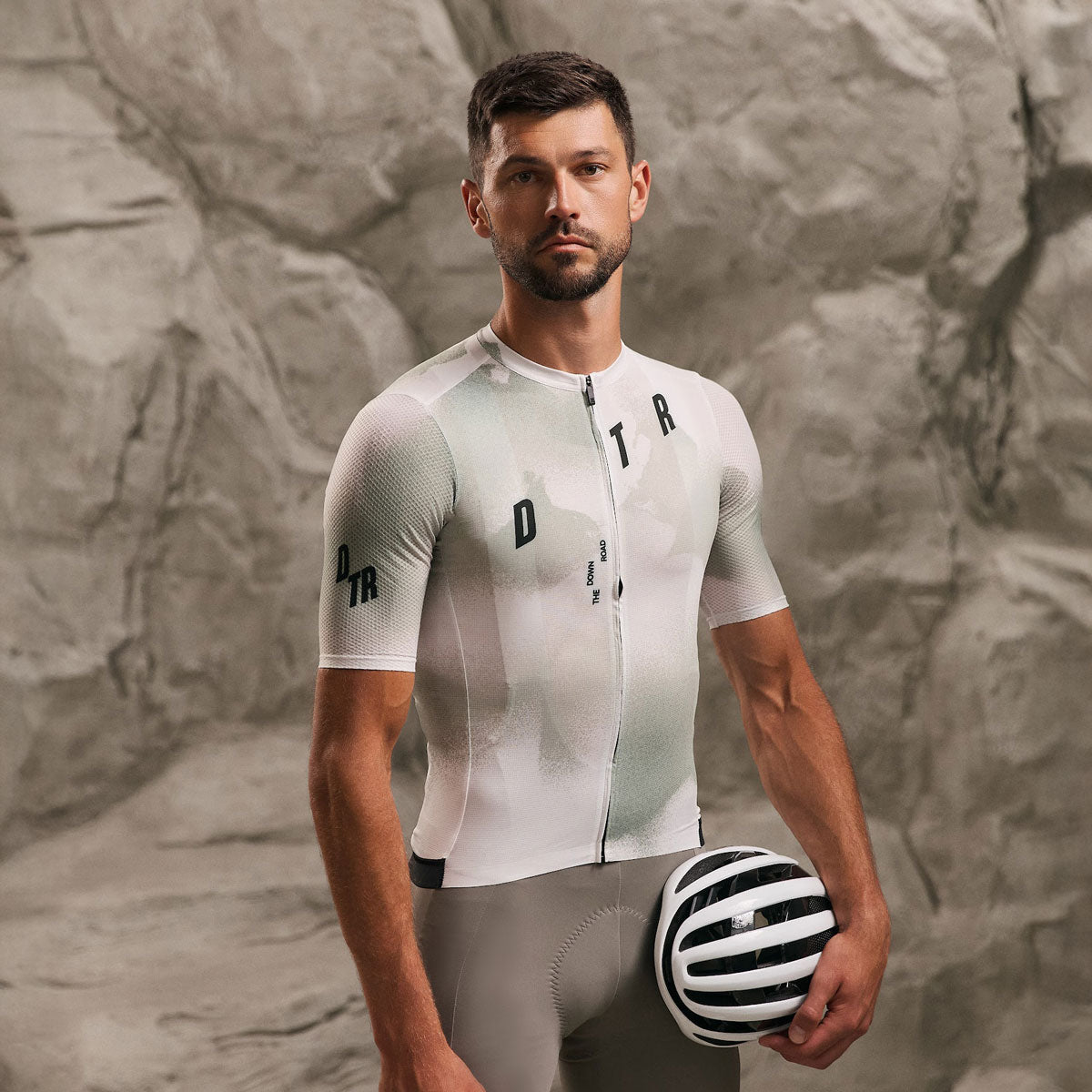
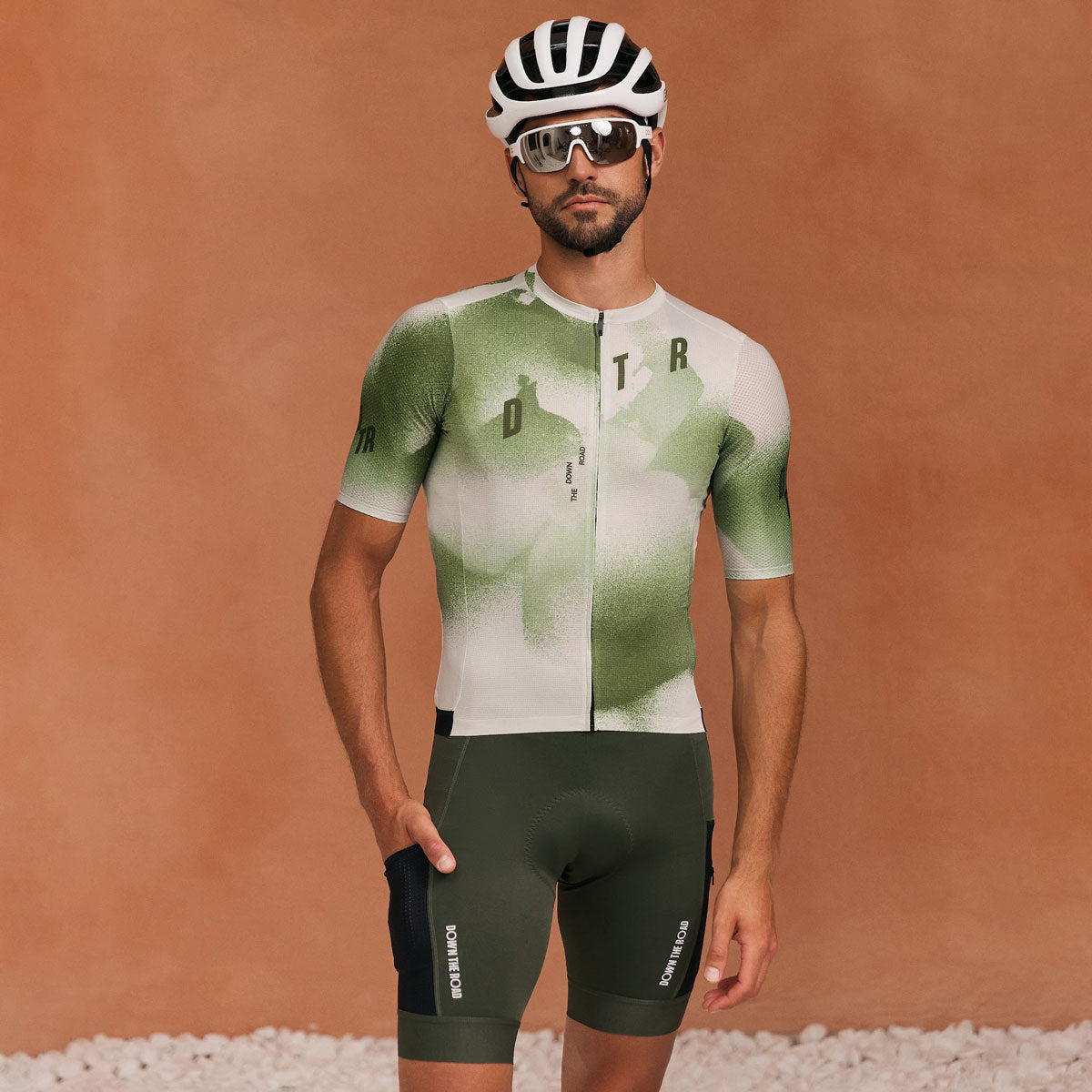
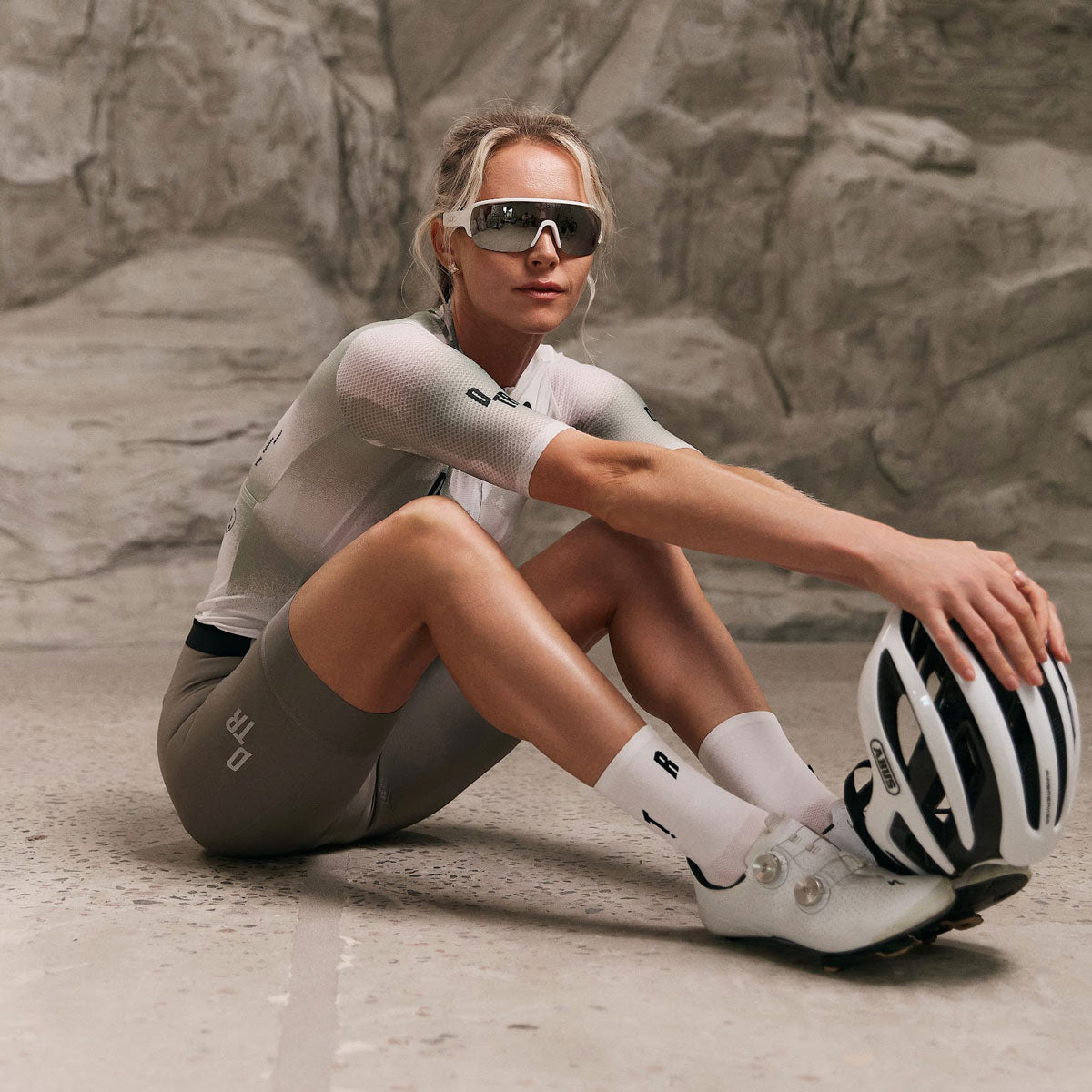
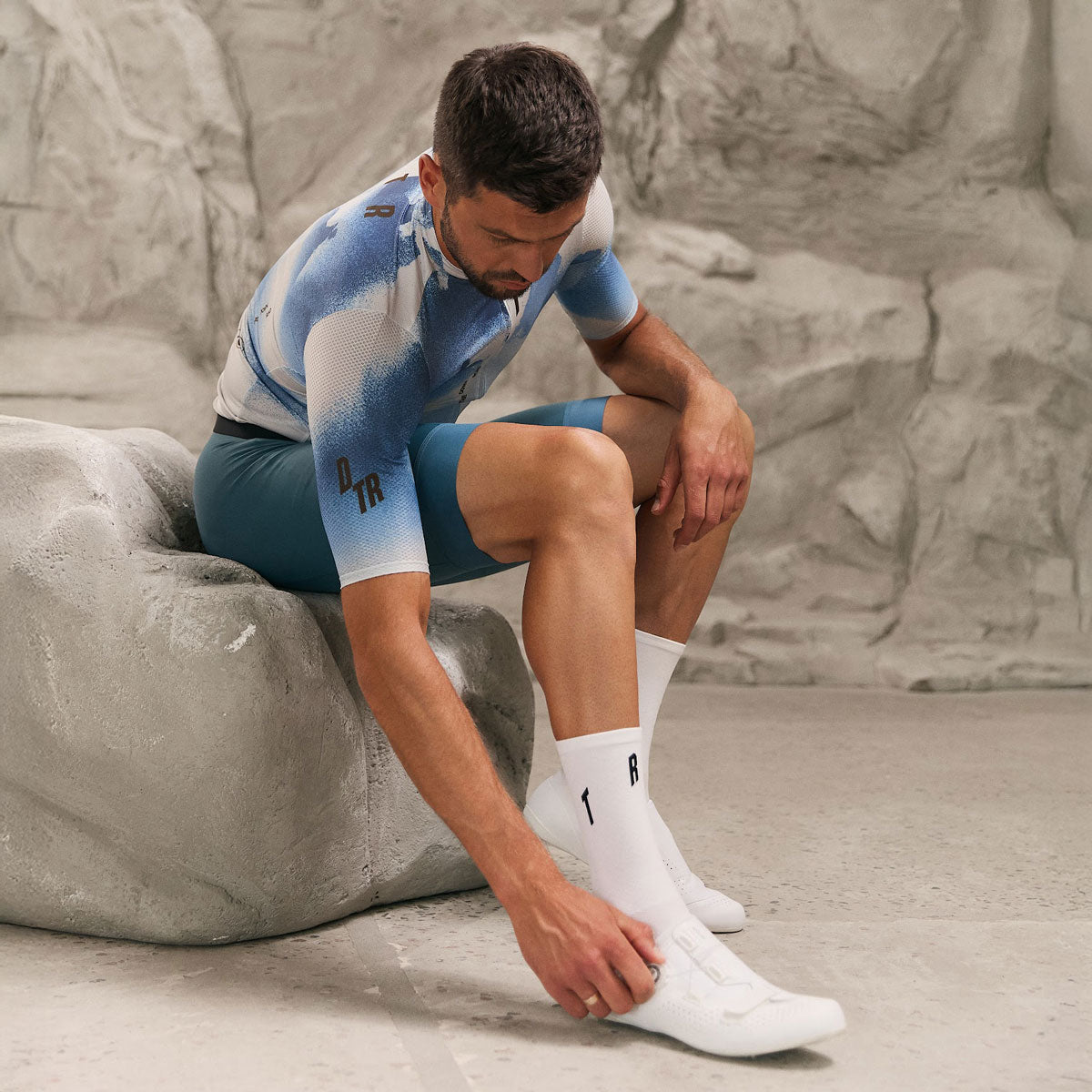
Well-made white bib shorts are not see-through, including in the riding position. Transparency is a fabric problem, not a colour problem: it comes from low fabric weight, a loose knit and too much stretch under load, and it shows up in cheap shorts of any pale colour. This guide covers what actually controls opacity, how to test a pair properly, and why the chamois sometimes shows through even when the fabric does not.
What makes a fabric go transparent
Three things decide whether light passes through: how much yarn is in the fabric, how tightly it is knitted, and how far it is stretched when you are on the bike. Fabric weight is measured in grams per square metre, and lighter is not automatically worse, but a light fabric has to be knitted densely to stay opaque.
Colour then changes how visible any transparency is. A dark fabric absorbs light, so even a fairly open knit reads as solid. White reflects and transmits, so the same knit shows what is behind it. That is why the problem is discussed as a white-shorts problem when it is really a construction problem that white exposes.
The last variable is the one most people miss. Fabric that is opaque at rest can open up once it is stretched around the seat and thigh in a forward riding position. A short that passes the mirror test standing up can still fail in the drops.
The test that actually tells you
Stand in front of a mirror and bend forward from the hip until your back is roughly flat, as it would be on the hoods. Look at the fabric across the seat and the outside of the thigh, where the panel is under the most tension. Do that in daylight, not under a dim bathroom bulb.
What you are looking for is not a general haze but a change in tone where the fabric is stretched furthest. If the seat panel goes noticeably lighter than the leg, the knit is opening under load. If the tone stays even, the short is fine, whatever it looks like held up against a window.
Holding the fabric up to a light is the test people default to and it is close to useless. Almost every technical lycra transmits some light when it is stretched flat between two hands with nothing behind it. That is not the state it is in when you are riding. It is also worth checking this at the same time as you check how tight the short should be, because the two problems share a cause.
Why the chamois sometimes shows and the fabric does not
A chamois is thicker, denser and usually a different colour from the outer fabric, so its outline can read through a pale short even when the fabric itself is completely opaque. That is a shadow, not transparency, and it is a manufacturing decision rather than a fault.
The fix on the maker's side is a chamois in a colour close to the shell, or a dark chamois with a deliberately dense panel over it. On your side, the thing to check is whether you can see the outline of the pad or the outline of what is under it. The first is cosmetic. The second means the fabric is too thin.
Multi-density construction can make the outline slightly more visible, because the denser zones sit differently under the shell. More density does not mean more thickness, and it is not a reason to avoid a well-built pad in a pale short.
Does wearing something underneath help?
No, and it makes things worse. Underwear under bib shorts adds seams that show through pale fabric more clearly than skin does, and it introduces a layer that holds moisture against you and creates friction. Bib shorts are designed to be worn against the skin.
If a short is genuinely too thin, the answer is a different short, not a layer under it. Adding fabric under a short that is already stretched thin also increases the stretch, which makes the original problem slightly worse rather than better, and the extra seams are a common starting point for chafing.
The one legitimate exception is a liner short worn under baggy shorts off-road, which is a different garment doing a different job.
Keeping light kit opaque over time
Fabric loses opacity as the elastane degrades and the knit relaxes. Heat is the main culprit: hot washes, tumble drying and drying on a radiator all shorten the life of the stretch fibres, and a short that has lost its recovery sits looser and stretches further under load.
Wash cold, inside out, on a gentle cycle, and dry flat and out of direct sun. Skip fabric softener, which coats the fibres and reduces both the wicking and the elastic recovery. Two or three years of regular riding is a reasonable working life for a pair; pale shorts show the end of that life earlier than black ones do, but they reach it at the same time.
Sunscreen and chain grease are the other two enemies of light kit. Neither affects opacity, but both stain permanently if they sit, so rinse rather than leave a pair in a bag overnight.
When to just choose black
Pale shorts are a fair choice for hot, dry racing and for team kit that has to match a design. They are a harder choice for winter training, wet gravel and long tours, where road spray and dirt show immediately and never fully come out.
Black is not warmer in any meaningful way on a moving bike, so heat is not the reason to pick it. Practicality is. If a pair has to survive three months of British winter, dark fabric will still look right at the end of it.
If you want light kit and want to stop thinking about it, the useful rule is to buy shorts where the brand states the fabric weight and holds a fit that passes the bent-over test. The DTR Core White women's bib short is built to that standard, and the rest of the range sits in men's and women's fits. Everything else about the colour is preference.
Common questions
Are all white cycling shorts see-through? No. Fabric weight and knit density decide it. Plenty of white shorts are completely opaque; plenty of cheap black ones would not be if they were pale.
Do white bib shorts get see-through when wet? Sweat and rain darken most technical fabrics slightly but do not make a dense knit transparent. If a pair goes translucent when wet, it was marginal when dry.
Should I size up to avoid it? No. A larger short stretches less at any given point but sits loose, bunches and rides up, which causes chafing. Fit to your measurements and choose a denser fabric instead.
Does a lighter fabric mean a cheaper short? Not necessarily. Some of the best hot-weather fabrics are light. The difference is whether the knit is dense enough to stay opaque at that weight.
Is this different for women's shorts? The physics are the same, but women's shorts are cut and panelled differently, so check the seat panel specifically rather than assuming a men's review transfers.
See the full bib short range at /collections/bib-shorts.
DTR — performance cycling and triathlon apparel, designed and developed in Ukraine.

Leave a comment
This site is protected by hCaptcha and the hCaptcha Privacy Policy and Terms of Service apply.