

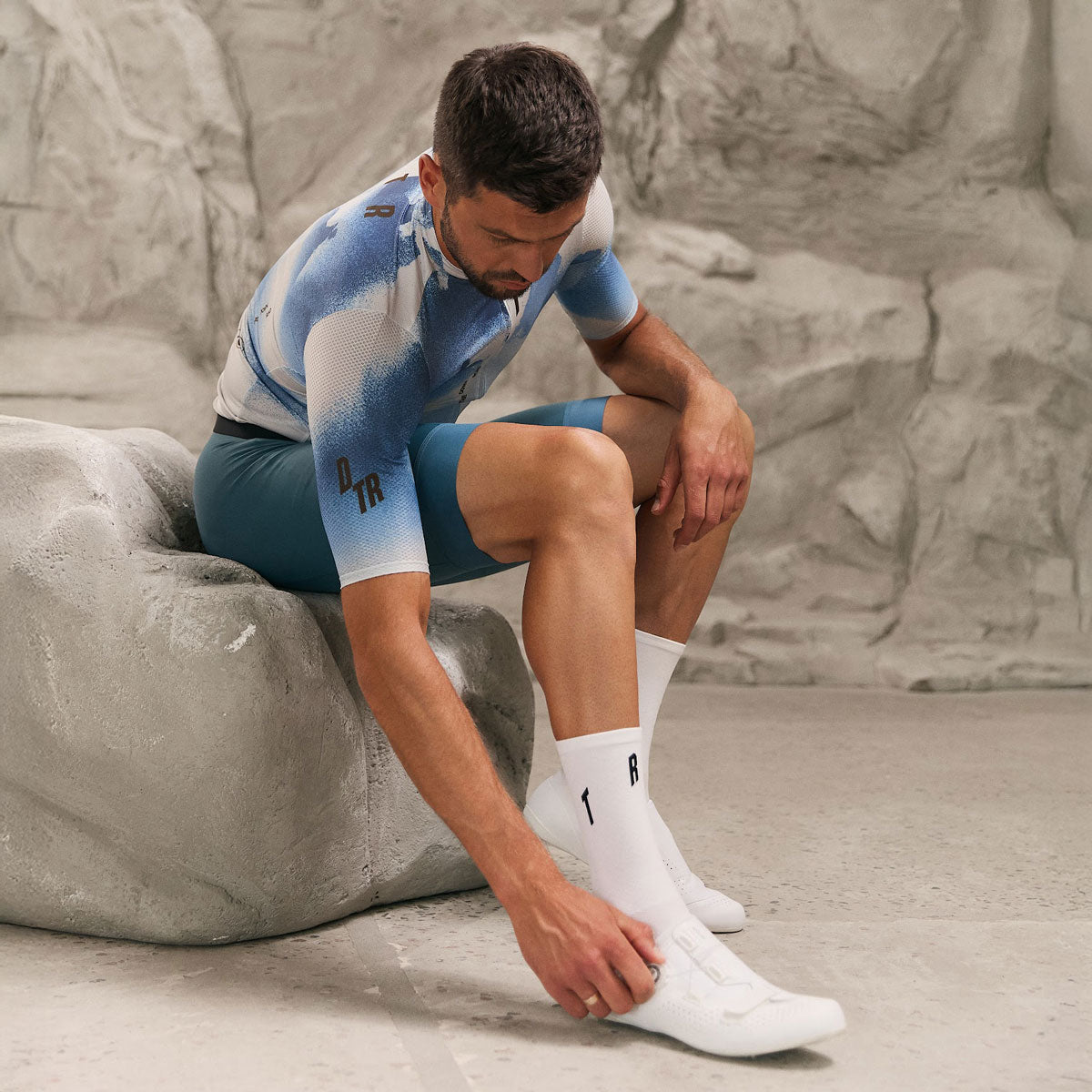
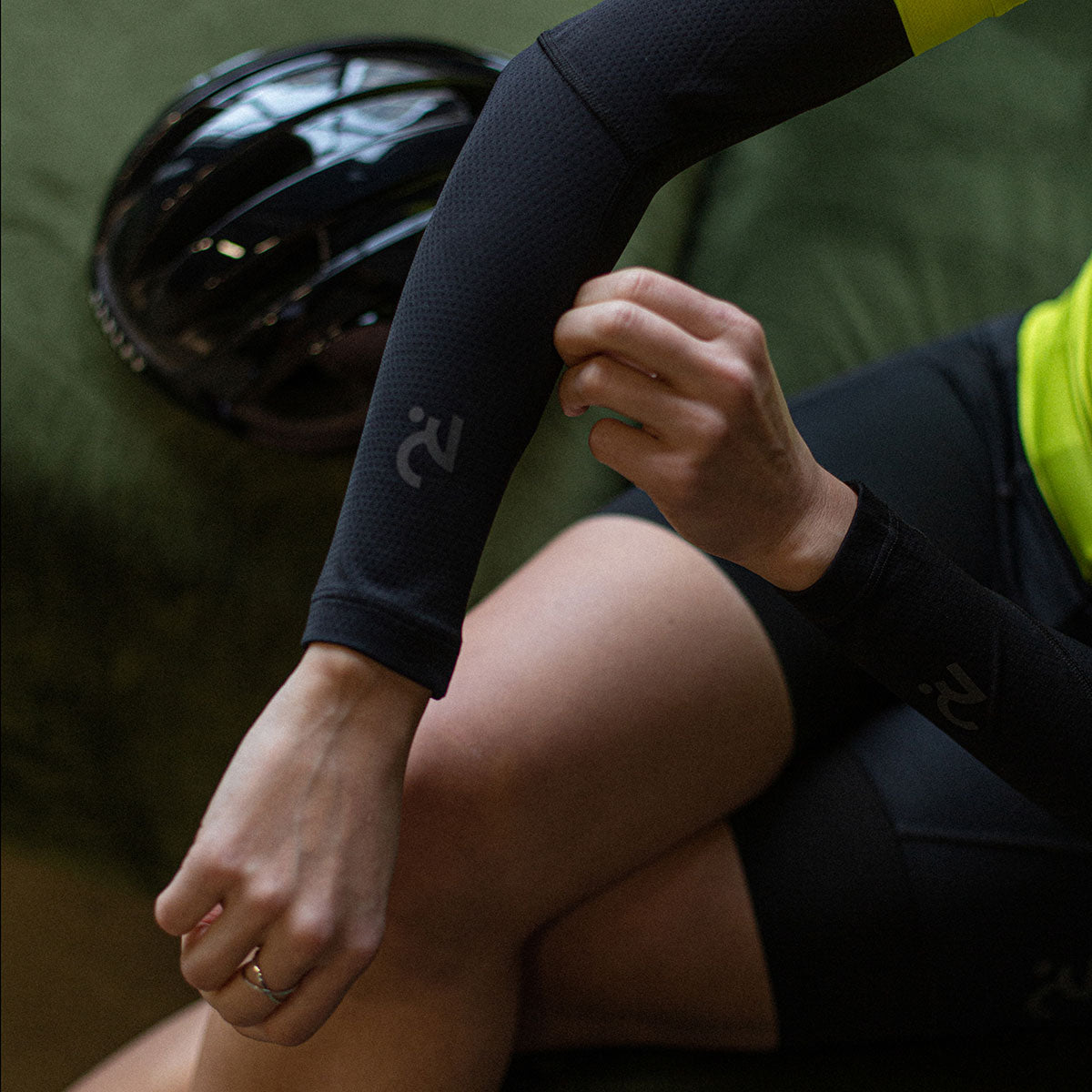
A cycling skull cap is a thin, close-fitting cap worn under the helmet that covers the whole head and the ears. A headband covers the ears only and leaves the crown open. A beanie is thicker, warmer and mostly for off the bike or for genuinely cold days. This guide covers what each one does, the temperature band each belongs in, and how to work out whether it will sit under your helmet without changing the way the straps fall.
What each piece actually covers
The three differ in coverage, not just warmth. A skull cap covers the crown, the ears and usually the nape. A headband is a single band across the forehead and ears, leaving the top of the head open to vent. A beanie covers the same area as a skull cap but in a thicker, lofted fabric. The DTR winter headwear range covers all three, plus a face covering for the coldest days.
That difference matters because your head is not the part that gets cold first. Your ears are. Wind moving across a helmet's vents at 30km/h finds the ears long before the crown starts to feel it, which is why a thin band can be enough on a day that feels far too cold for bare skin.
The crown, meanwhile, is where you dump heat once you start working. Cover it too early and you overheat on the first climb, then get cold on the descent because you are damp. Coverage is a choice about where you want to lose heat, not just how much.
Which one for which temperature
As a starting point for a moderate road ride: above roughly 12°C you need nothing. From about 12°C down to 6°C a headband handles the ears while the crown keeps venting. From about 8°C down to 0°C a thin cap under the helmet is the right call. Below freezing, add face and neck coverage rather than a thicker hat.
Those bands overlap on purpose. Wind speed, ride intensity and whether you sweat heavily all shift them by two or three degrees. A hard chaingang at 6°C can feel warmer than a steady endurance ride at 10°C, and a long descent will always feel five degrees colder than the climb that preceded it.
The practical test is the first ten minutes. If you are comfortable leaving the house, you are overdressed. You want to feel slightly underdressed at the door and correct by the time you are properly riding. The temperature guide applies the same logic to the rest of the kit.
Will it fit under your helmet?
A cap designed for cycling is cut thin enough that your helmet fits as it did before, with the retention dial in roughly the same position. If you have to loosen the cradle by more than a click or two, the fabric is too thick and the helmet is no longer sitting where it was fitted to sit.
Check three things before you commit to it for a winter. First, the helmet should still sit level, not perched higher at the back. Second, the straps should still form a clean V under each ear rather than being pushed forward by a bunched hem. Third, the retention cradle at the rear should grip the occipital bone, not slide up over fabric.
A beanie almost always fails at least one of these. That is not an argument against beanies, it is an argument for wearing them at the café stop and on the commute rather than under a race helmet.
Are ears enough, or do you need the whole head?
For most riders on most autumn days, ears are enough. The ear is thin, exposed, poorly insulated and sits directly in the airflow coming through the front vents. Cover it and the perceived temperature of the whole ride shifts noticeably, without trapping the heat you are trying to shed from the crown.
Move to full coverage when one of two things is true: the temperature is low enough that your forehead aches on descents, or the ride is long enough that you will spend real time at low intensity, soft-pedalling in a group or waiting at a café. Both are situations where the crown stops producing surplus heat.
There is also a rain case. A thin cap with a peak keeps spray off your eyes far better than a headband, which is why some riders keep one in a jersey pocket year-round rather than only in winter.
What the fabric needs to do
Two jobs, in this order: move moisture and block wind. Warmth is the by-product. A head covering that holds sweat against your scalp will be colder after twenty minutes than bare skin was at the start, because evaporation under a helmet vent is brutally efficient.
Look for a technical knit with a brushed inner face rather than a heavy fleece. The brushed surface traps a thin layer of still air against the skin and pulls moisture outward; heavy fleece traps water. Flatlock seams matter more here than almost anywhere else in the kit, because a raised seam under a helmet pad becomes a pressure point about ninety minutes in.
Some caps add a wind-resistant panel across the forehead and ears while leaving the crown breathable. That combination is worth seeking out. It targets the two coldest areas without sealing the one area you need open.
Working head, neck and face together
Below about 3°C the limiting factor stops being your head and becomes the gap between your collar and your chin. Air pushed up from the chest finds that gap on every descent. A neck warmer pulled up over the jaw does more for comfort at that point than a thicker cap would.
Below freezing, or riding into a hard headwind, a face covering across the nose and cheeks is the last piece. Add it separately rather than looking for one garment that does everything, because you will want to pull it down on the climbs and back up over the top. Hands and feet follow the same logic: winter gloves and overshoes are worth getting right before you add bulk anywhere else.
The principle is the same one that governs the rest of a winter kit: several thin, adjustable layers that you can change while moving, rather than one thick layer you are stuck with for three hours.
Common questions
Can I wear a summer cycling cap in winter? A cotton or thin polyester cap will keep rain out of your eyes but does very little for warmth and holds sweat. It is a rain tool, not a cold tool.
Do I need to size up my helmet? No. If a properly cut cap forces a helmet size change, the cap is too thick for riding.
Headband or skull cap for a turbo session? Neither. Indoors you are trying to lose heat, not keep it.
Will a headband stay put under a helmet? Yes, if it sits under the straps rather than over them. Put the head covering on first, then the helmet, then adjust the retention dial.
Merino or synthetic? Merino handles smell better over multiple rides. Synthetic dries faster and holds its shape longer through repeated washing. Both work; the difference is smaller here than in a base layer.
See the winter headwear range at /collections/cycling-headwear.
DTR — performance cycling and triathlon apparel, designed and developed in Ukraine.

Leave a comment
This site is protected by hCaptcha and the hCaptcha Privacy Policy and Terms of Service apply.