

Women's bib shorts differ from men's in three places that matter: the shape and placement of the chamois, the strap and bib construction over the chest, and the cut through the hip and thigh. Everything else — fabric, gripper, seam construction — is the same engineering applied to a different set of proportions. This guide covers what is genuinely different, how a pair should fit, and how to size when you fall between.
What is actually engineered differently
Three things change, and they are structural rather than cosmetic. The chamois is cut for a different pelvic geometry, the bib straps are routed to clear the chest without cutting across it, and the panels through the hip and thigh follow a different curve. A women's short is designed from a different block — it is not a men's short scaled down and recoloured.
That distinction is worth being precise about, because it is where most disappointment comes from. A short that has simply been shrunk will feel wrong in exactly the places listed above: the pad sits too far back, the straps pull inward, and the leg gapes at the outside while binding at the inside.
The chamois: shape before thickness
The chamois in a women's short is generally wider at the rear and shorter through the front, because it is supporting a wider average sit-bone spacing and does not need the length a men's pad carries forward. Density is mapped to that shape — firmer directly under the sit bones, progressively softer toward the edges so there is no hard perimeter to press into soft tissue.
Thickness is the most misunderstood part. More density is not more thickness, and a thicker pad is not a more comfortable one. A thick, uniform pad bunches under load and pushes tissue out of position, which is the opposite of what you want on a long ride. A well-mapped multi-density chamois is usually thinner than riders expect. We go deeper into this in chamois density explained.
Straps, and the stop-to-pee problem
Bib construction is the single most common reason riders hesitate over bibs rather than waist shorts, and it is a solvable design problem. Straps need to sit wide enough to clear the chest entirely, be soft-edged so they do not dig at the shoulder, and carry no seam where a jersey or base layer will rub across them.
The practical objection — having to half-undress at a roadside stop — is real and worth planning around. Designs vary: some use a drop-tail or split-rear panel, some use a halter-style strap arrangement, and some accept the trade and prioritise a cleaner front. If you ride long distances or in cold weather, treat this as a primary buying criterion rather than an afterthought, because it determines whether you drink enough on a five-hour ride.
How a pair should fit
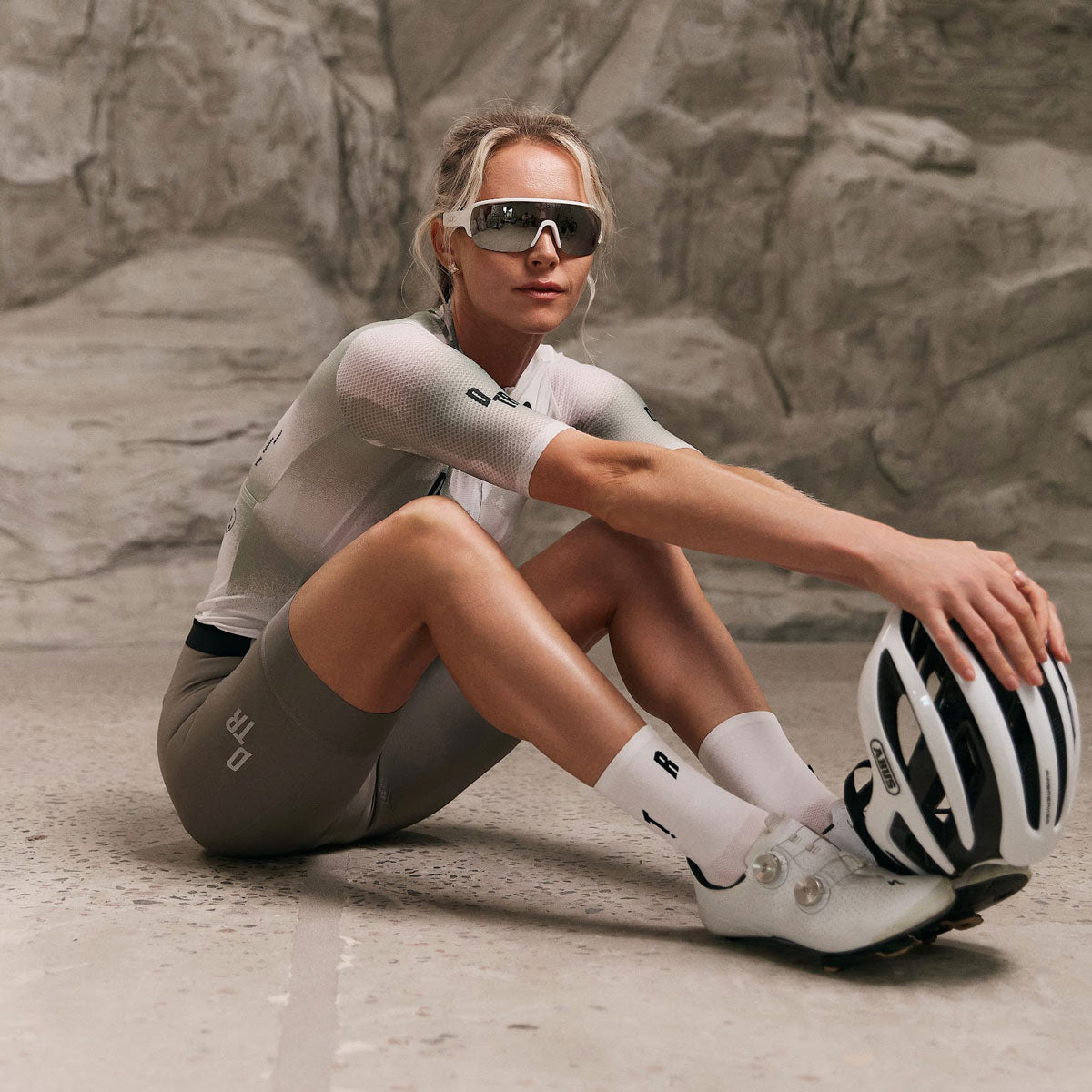
They should feel firm and evenly compressive everywhere, with no single point of pressure. Pull them on and check four things: the leg opening lies flat against the thigh without gripping into a ridge; the chamois sits centred and in contact with no air gap; the straps hold the short up without tension when you get into the drops; and there is no loose fabric gathering behind the knee.
Off the bike a good pair feels slightly too tight. That is correct — the fit is designed around a rider bent forward at the hips, not standing upright. Judge them in the riding position, or better, on a trainer for twenty minutes. Our guide on how tight bib shorts should be covers the full check.
Getting the size right when you are between two
Size to your hip measurement first and your waist second. The hip and thigh carry the load and determine whether the chamois stays put; a waist that is marginally loose is a non-issue in a bib, because the straps are doing that job anyway.
Between two sizes, take the smaller one if the fabric has strong recovery and you ride in a low, aggressive position, and the larger if you ride more upright or are between sizes at the thigh specifically. A short that is too big is the worse mistake: the pad shifts, the legs ride up, and you get friction exactly where you do not want it.
Which pair for which riding
Match the short to ride length rather than to how fast you go. Under two hours, a lighter short with a slimmer pad is more comfortable and less bulky. Beyond three or four hours, the multi-density construction and a wider gripper start paying for themselves, and a cargo option is worth considering if you carry your own food.
For racing and hard group riding, a race-fit cut with a wide, flat silicone gripper holds the leg without leaving a mark. For gravel and all-day riding, prioritise pad mapping and strap comfort over the last few grams.
Comfort, chafing and when to stop guessing
Most discomfort traces back to fit, saddle position or ride duration rather than to the short itself. A pad that is too thick, a short that is too large, or a saddle that is a few millimetres out will all produce the same symptom. Change one variable at a time, and give each change a few rides before judging it.
Chafing and saddle sores are common and usually respond to better fit, clean kit every ride and chamois cream. If a sore is persistent, painful, spreading or does not settle with rest, see a doctor rather than riding through it — that is a medical question, not a kit question. Our overview of saddle sores covers the practical prevention side.
Frequently asked questions
Are women's bib shorts really different, or just marketing?
Genuinely different when they are designed properly. The chamois shape, strap routing and hip and thigh panels are drawn from a different block. A short that differs only in colourway and size label is not offering you anything.
Should you wear underwear underneath?
No. The chamois is designed to sit directly against skin. Underwear adds seams, holds moisture and is one of the more reliable ways to cause chafing on a long ride.
Bibs or waist shorts?
Bibs, for anything over an hour. They hold the chamois in position without a waistband compressing your stomach in a forward-leaning position. Waist shorts win only on convenience at stops.
How tight should the leg grippers be?
Firm enough that the leg does not ride up, loose enough to leave no indentation after a ride. A wide, flat silicone gripper holds better at lower pressure than a narrow elastic band.
How long should a pair last?
With regular riding, one to three seasons. Replace them when the fabric goes sheer under stretch or the chamois stops recovering its shape — both happen before the short looks worn out.
See the women's range at /collections/womens-cycling-triathlon-apparel.
DTR — performance cycling and triathlon apparel, designed and developed in Ukraine.

Leave a comment
This site is protected by hCaptcha and the hCaptcha Privacy Policy and Terms of Service apply.