

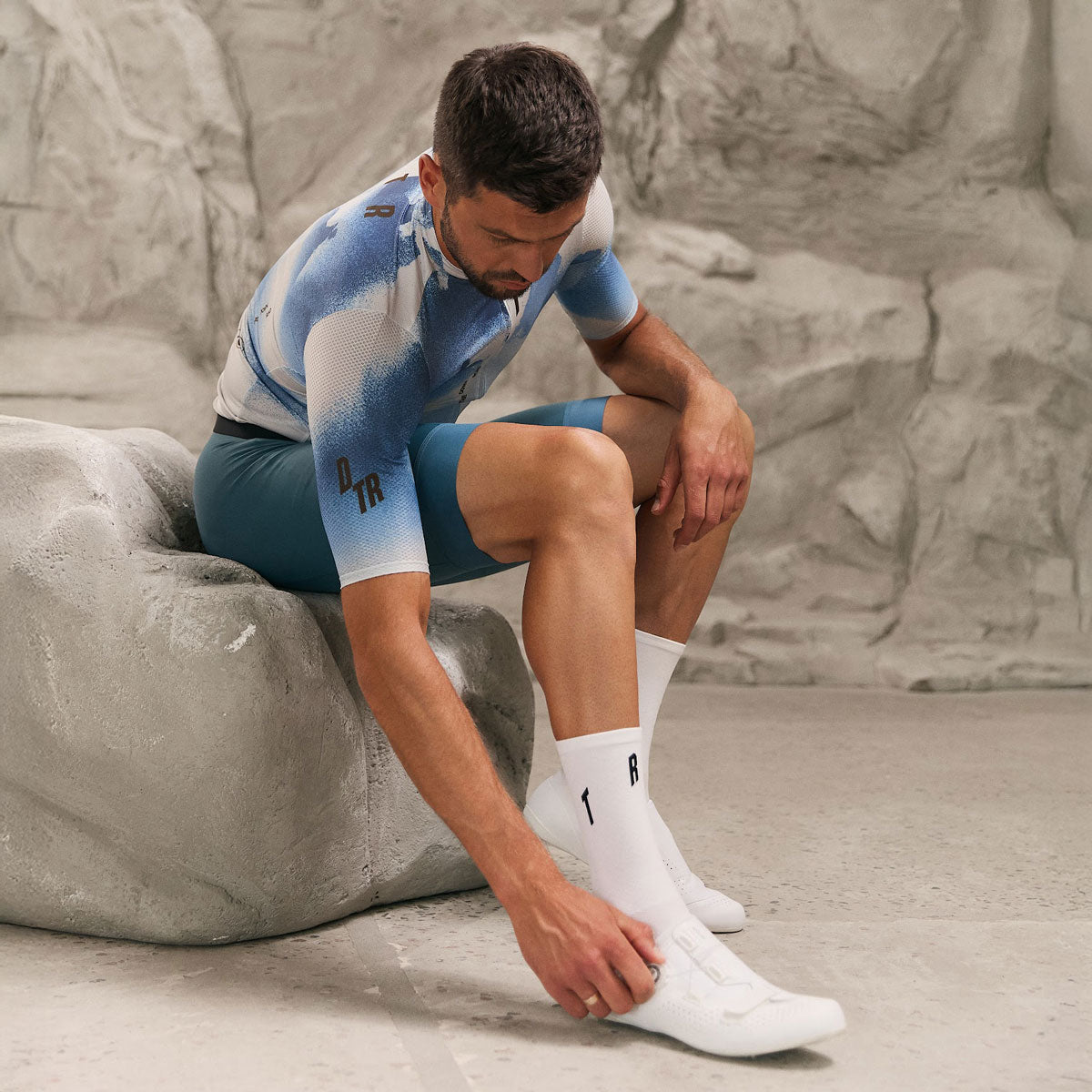
Train in bib shorts for bike-only sessions, and in tri shorts for anything that finishes with a run. The difference is the chamois: a cycling chamois is thicker and multi-density, built for hours in one position, while a tri pad is thin and quick-drying so it can swim and run without holding water. This guide covers which to use for which session, and why the answer changes as your rides get longer.
The chamois does all the work in this decision
A cycling chamois is engineered for sustained pressure in a fixed position. It is denser under the sit bones, softer toward the edges, and thick enough to matter over four hours. A tri pad is deliberately minimal — thin, closed-cell so it sheds water fast, and shaped to disappear when you get off the bike and start running.
Each is bad at the other's job. Ride four hours on a tri pad and you will feel every one of the last ninety minutes. Run off the bike in a full cycling chamois and you are carrying a wet sponge between your legs. Neither is a design flaw; they are solving different problems.
When bib shorts are the right call
Use bibs for every session where the bike is the whole workout. Long endurance rides, threshold and sweet-spot intervals, group rides, winter base miles — anything where you get off the bike and stop. You are training the bike leg, so you may as well be comfortable enough to hold position and actually hit the numbers.
The straps matter as much as the pad here. Bibs hold the chamois in place without a waistband compressing your stomach in an aero position, which is why almost every serious cyclist stops using waist shorts within a season. For anything over two hours, this is not a close contest.
When tri shorts earn their place
Use tri shorts when the session includes a run, a swim, or a transition. That means brick workouts, open-water-to-bike sessions, race-pace simulations and any day where you are rehearsing what race morning actually looks like. The thin pad is the price of admission for being able to run immediately without chafing.
They are also the right choice for short, sharp bike sessions in hot weather, where less fabric and faster drying beats a plush pad you do not need for forty minutes. Sprint and standard-distance athletes often train the bike almost entirely in tri kit for exactly this reason.
Brick sessions: rehearse the real thing
Bricks are the one session where kit choice is part of the training. The point of a brick is to teach your body the bike-to-run transition, and that includes how the pad feels on the first kilometre of the run and whether a seam rubs once you are sweaty. Doing them in bibs removes the part you most need to practise.
This is where problems get found. Chafing at the inner thigh, a gripper that rolls under a race belt, a pad that stays wet longer than expected — all of it surfaces in training or it surfaces on race day. There is no third option.
How long can you ride in tri shorts?
Most athletes are comfortable up to around two to three hours, and it varies more by rider than by product. Sit-bone spacing, saddle choice and how much you move around on the bike all shift that number. If you race middle or long distance, you will find your own limit quickly — and it is worth knowing precisely where it is before an event, not during one.
Beyond that limit the answer is not usually a thicker tri pad. It is a better-fitting saddle, a slightly different position, or accepting that your long rides happen in bibs and your race-specific work happens in tri kit. Long-course athletes typically split their week exactly that way.
What this means for race day
Race in what you have trained in, over the distance you have trained at. The single most common kit mistake in triathlon is racing long in a combination that has never been tested past ninety minutes — new suit, new saddle, or both, on the day it matters. Nothing about a race is the right time to find out how a pad behaves at hour three.
If you are choosing between a one-piece and a two-piece for the race itself, that is a separate decision about fit, nutrition access and heat, and we cover it in trisuit vs tri top and shorts. What does not change is the rule: test it over race distance first.
Frequently asked questions
Can you use tri shorts as cycling shorts?
For short and moderate rides, yes. Past two or three hours most riders want a proper cycling chamois. The pad is thinner by design, not by compromise.
Can you swim in bib shorts?
No. A cycling chamois absorbs water, holds it, and becomes heavy and cold. Bibs are bike-only.
Do you wear anything under tri shorts?
No. Like a cycling chamois, the tri pad sits directly against skin. Anything underneath adds seams and holds moisture through all three disciplines.
Are tri shorts and trisuit bottoms the same?
Broadly, yes — the same thin quick-dry pad and the same compressive fit. A trisuit integrates it into one piece; tri shorts leave you free to change the top layer between sessions.
Which should a first-season triathlete buy first?
Tri shorts, if you are only buying one thing and you are racing sprint or standard distance. Add bib shorts once your long rides start regularly passing two hours.
See the trisuit and tri kit range at /collections/trisuits.
DTR — performance cycling and triathlon apparel, designed and developed in Ukraine.
For the definitional and race-use angle, see Triathlon Shorts: What They Are and When to Train in Them.

Leave a comment
This site is protected by hCaptcha and the hCaptcha Privacy Policy and Terms of Service apply.