

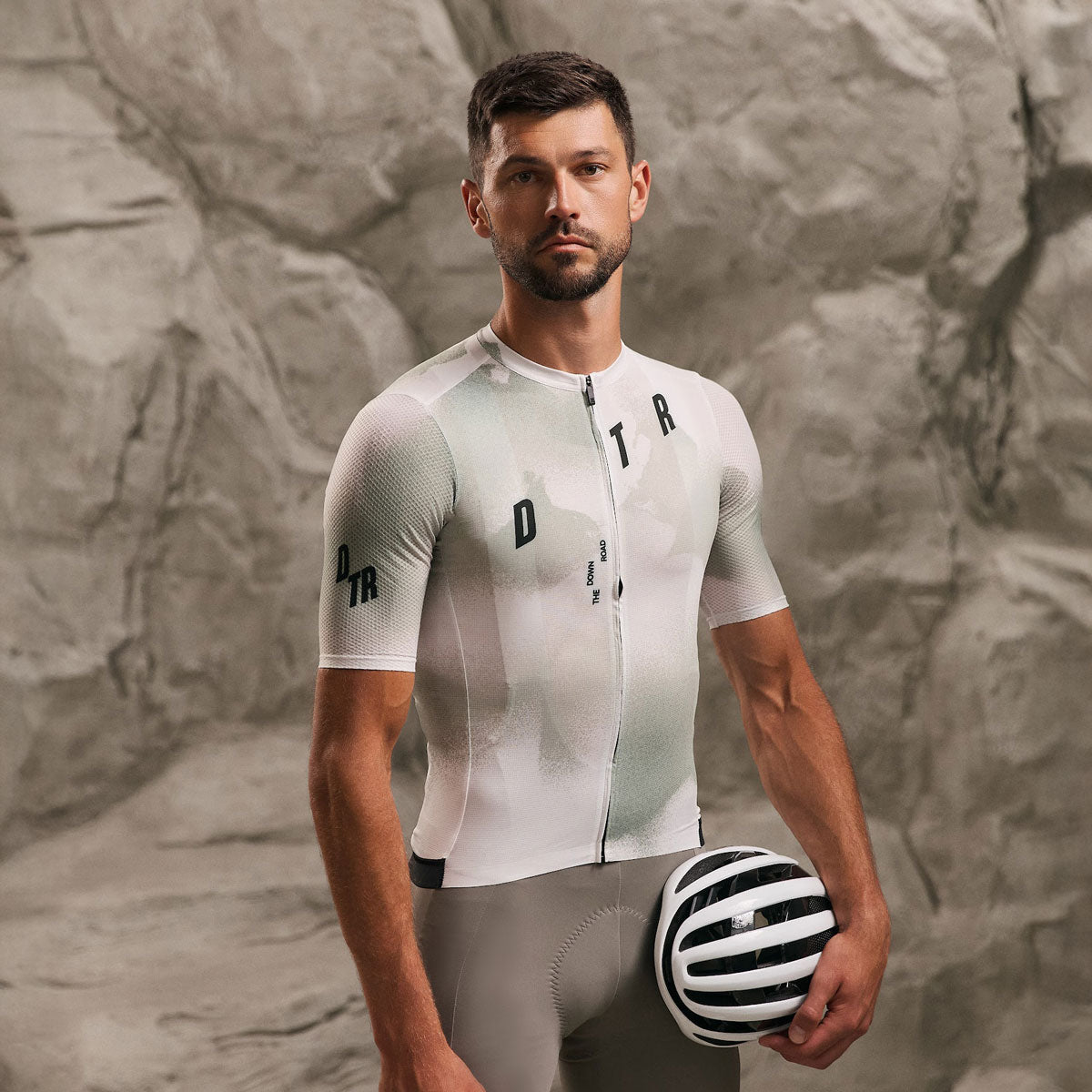
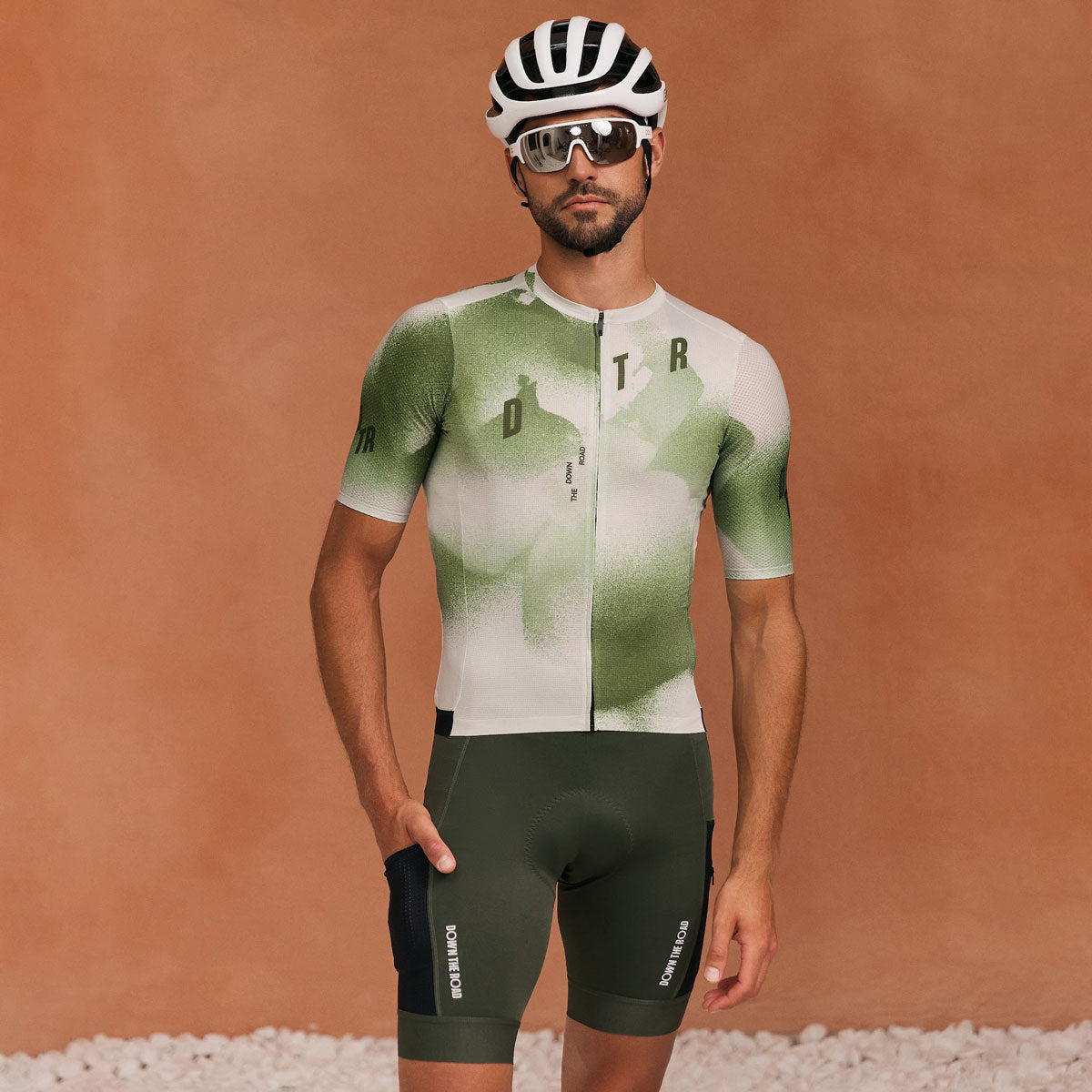
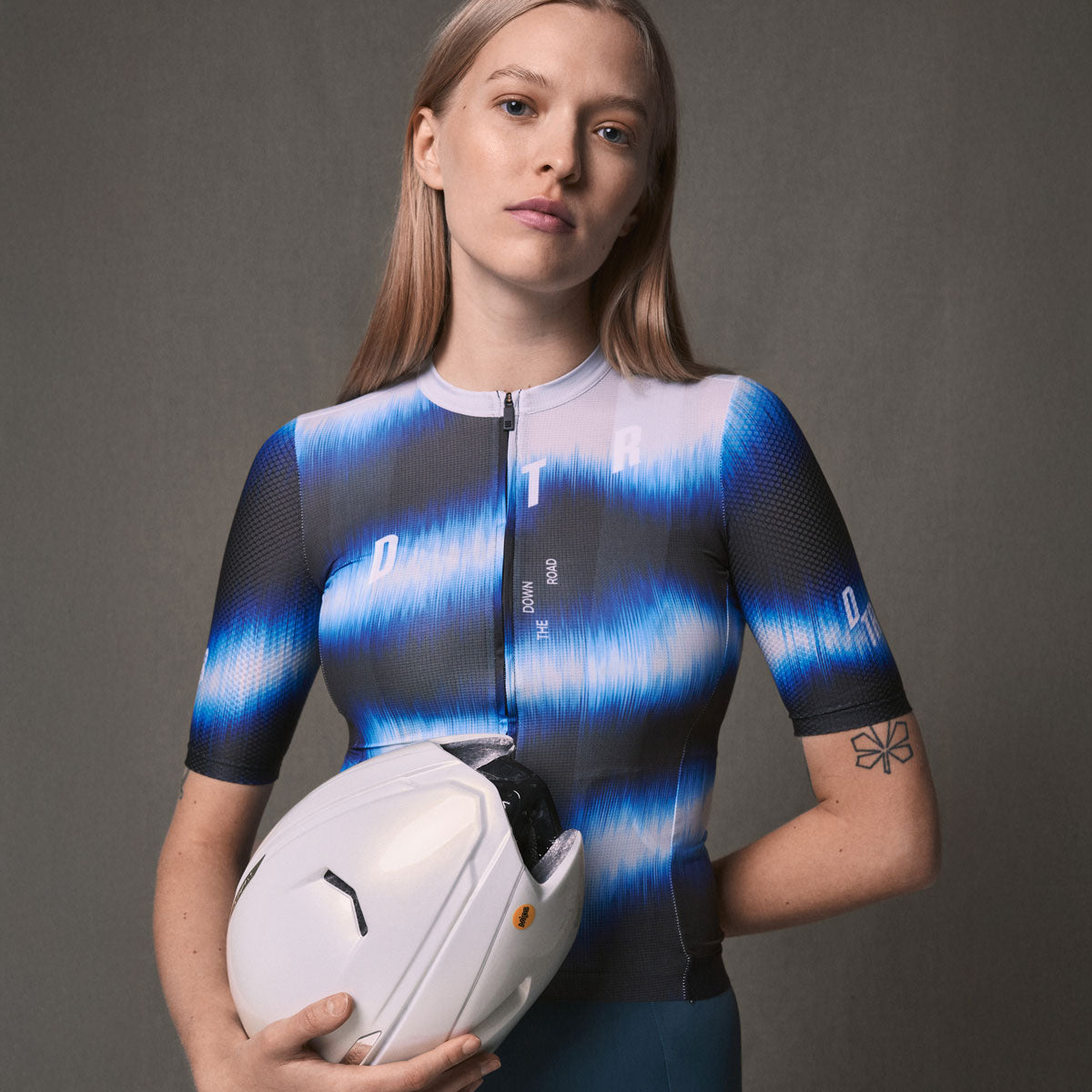
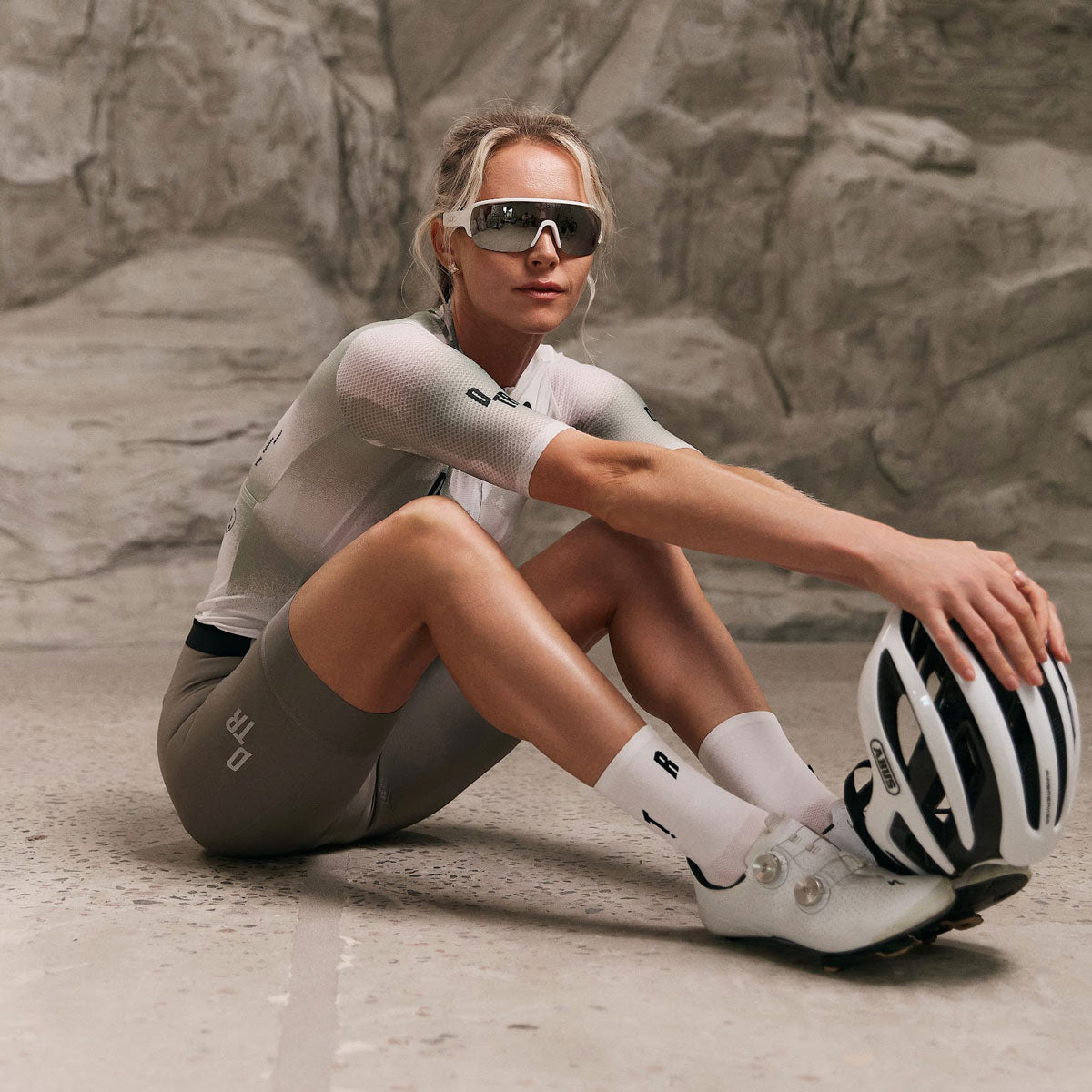
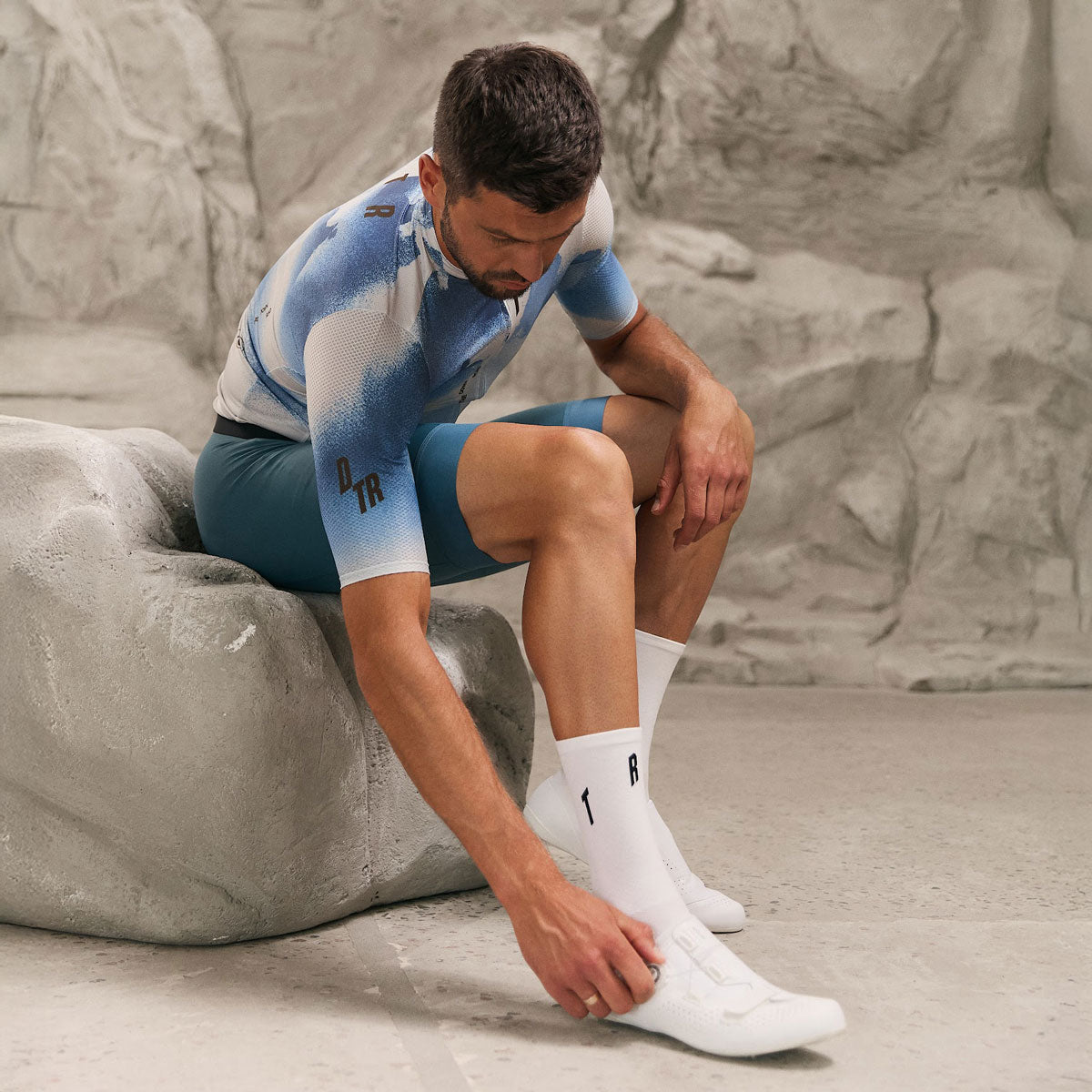
A trisuit should fit like a second skin — firm and evenly compressive everywhere, with no loose fabric and no single point that digs in. It will feel slightly too tight standing in a changing room and correct the moment you are in the swim or on the bike. This guide covers what to check, in what order, and how to decide when you fall between two sizes.
What a correct fit feels like
Held, not squeezed. The suit should be in continuous contact with your skin from shoulder to mid-thigh, with no air gaps at the lower back, no rucking at the waist and no fabric you can pinch and pull away more than a centimetre or so. Breathing should be completely unrestricted.
The standing-up test is misleading, which is why so many suits get returned unnecessarily. The pattern is cut for a body folded forward on a bike and extended in the water, not for standing upright. Judge it in position, and if you can, ride in it on a trainer for twenty minutes before deciding.
Start with the shoulders
Shoulders come first because the swim is where a bad fit costs you the most. Raise both arms overhead and rotate through a full stroke. The suit should follow without pulling the neckline down, without dragging the chamois upward, and without any binding across the upper back. If reaching forward tugs the whole suit, it is too short in the torso. For how a well-fitted suit then behaves in the pool and open water, see can you swim in a trisuit.
Torso length is the measurement that decides more than any other. A suit that is too short pulls at the shoulders and rides up in the crotch; one that is too long bunches at the waist and traps water. Most manufacturers publish a torso measurement precisely because it is the hardest thing to correct.
The chamois has to stay put
The pad should sit centred and in constant contact, with nothing to shift when you get on the bike. A tri pad is deliberately thin and quick-drying — it is there to take the edge off a bike leg, not to feel like a cycling chamois — so it relies almost entirely on the suit holding it in position rather than on bulk.
Check it in the riding position, not standing. If it drops away from you when you lean forward, the suit is too big through the torso or the seat, and no amount of pad thickness will fix that. A pad that moves is the single most reliable source of discomfort on a long bike leg.
Leg grippers and what happens on the run
Leg openings should hold without leaving a deep mark. A wide, flat silicone gripper distributes pressure across more surface and holds better at lower tension than a narrow elastic band. Standing still, you should be able to slide a finger under the gripper with mild resistance.
The run is where errors show. Grippers that are too tight restrict circulation over an hour or more; too loose and the leg rides up and chafes at the inner thigh with every stride. Test it by running for five minutes in the suit before race week — not in transition on the day.
Sleeved and sleeveless fit differently
Sleeved suits fit tighter through the chest and upper arm by design, because the sleeve only delivers its aerodynamic benefit when the fabric is drum-tight against skin. A sleeve with any slack is doing nothing except adding material. If you are between sizes in a sleeved suit, the smaller one is usually correct.
Sleeveless suits are more forgiving across the shoulders and easier to get in and out of, which matters if you are new to transitions or racing somewhere hot. They also suit riders who find sleeved suits restrictive on the swim. Neither is faster in every case — it depends on your build and the conditions.
When you are between two sizes
Go by torso length first, chest second, waist last. If your torso measurement sits in the larger size, take the larger one even if the chest suggests otherwise — a suit that is short in the body will never be comfortable, whereas slightly generous through the chest is livable.
For racing, particularly in a sleeved suit, take the smaller size when the choice is genuinely marginal and the fabric has strong recovery. For a first season, longer distances, or if you are unsure, take the larger. Being able to breathe and eat on the bike matters more than a few watts.
The fit mistakes that come up most
Sizing to your usual clothing size is the most common, and it produces a suit one or two sizes too big almost every time. The second is judging the fit dry and standing up, when a trisuit behaves differently once wet and folded into position. The third is buying new for a target race and discovering the fit problems mid-event.
Wear it for a full brick session at least a few weeks out. Chafing points, a gripper that rolls, a neckline that rubs under a wetsuit — all of it surfaces there rather than on the day. If you are also working out what goes underneath, see what to wear under a wetsuit.
Frequently asked questions
Should a trisuit be tight?
Yes — firm and continuous, without restricting breathing or shoulder rotation. Loose fabric drags in the water, flaps on the bike and chafes on the run.
Is it meant to feel tight when standing?
It is. The cut assumes a forward-folded position on the bike and an extended one in the water. Standing upright is the one position it is not designed around.
Do you wear anything underneath?
No. The pad sits directly against skin, and anything underneath adds seams and holds water through the swim.
Should you size up for long-distance racing?
Not automatically, but err larger if the decision is close. Over four or five hours, comfort, breathing and nutrition access matter more than the marginal aerodynamic gain.
Will it stretch out?
A well-made suit relaxes slightly with the first few wears and then holds. If a suit is noticeably loose when new, it will not shrink to fit — size down instead.
See the trisuit range at /collections/trisuits.
DTR — performance cycling and triathlon apparel, designed and developed in Ukraine.
For a race-specific next step, see Kona World Championship Race Kit: Heat, Humidity and Transitions and Next-Gen Tri-Suits: What Performance Innovation Matters.
Before dialling in fit, read What Is a Trisuit? The One-Piece Explained.

Leave a comment
This site is protected by hCaptcha and the hCaptcha Privacy Policy and Terms of Service apply.