




Aero socks do reduce drag at the ankle, and the effect is real enough that cycling's governing body wrote a rule to limit how far it could be taken. The saving is small, it scales steeply with speed, and it is worth chasing only once your position and the rest of your kit are already sorted. This guide covers the mechanism, the height rule, how much it realistically buys you, and when a standard technical sock is the better choice.
What an aero sock actually is
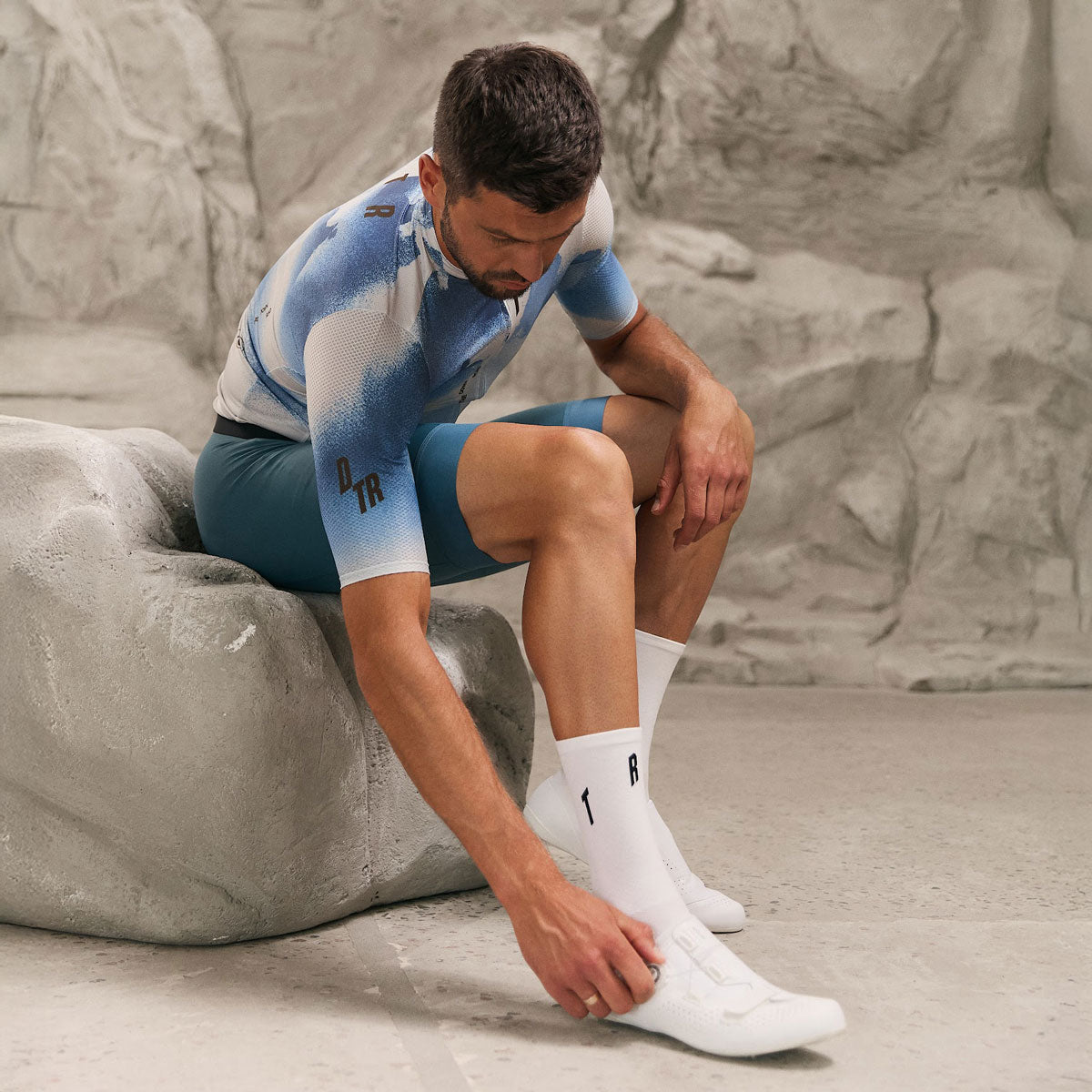
A tall sock with a deliberately textured surface — usually a raised rib or a dimpled knit — covering the lower leg from the shoe to somewhere below mid-calf. The height and the texture are the two functional features. Everything else, including the fabric weight and the cuff, is ordinary technical sock construction.
It is not a compression garment, and it does not do what a compression sock does. If you are looking for post-ride recovery wear, that is a different product with a different job — covered in our compression socks guide.
How the drag saving works
The lower leg is a roughly cylindrical shape moving through air, and a smooth cylinder is aerodynamically poor. Air flowing over it separates early, leaving a wide low-pressure wake behind the leg that pulls you backwards. That separation is the drag.
A textured surface trips the airflow into a turbulent boundary layer before it separates. Turbulent flow clings to the surface for longer, so it separates further round the back of the leg, and the wake behind it is narrower. Narrower wake, less pressure drag. It is the same principle that puts dimples on a golf ball, applied to a shape that happens to be attached to you and moving at roughly the right speed for it to work.
The height matters because it extends this treated surface up the leg. A short sock only manages the ankle; a taller one manages most of the calf, which is a larger frontal area than most riders assume.
How much faster, really?
Less than the marketing on the category would suggest, and more than nothing. Published wind-tunnel work from independent testers generally puts textured tall socks in the same order of magnitude as other small kit refinements — a handful of watts at racing speed, not a transformative gain. We have not run our own tunnel protocol, so we are not going to quote you a number as though we had.
Two things determine whether that saving is worth anything to you. Speed is the first: aerodynamic drag rises with the square of velocity, so a refinement worth a few watts at 45 km/h is worth a small fraction of that at 28 km/h. The second is what else is unoptimised. If you are riding in a flapping jersey, aero socks are the wrong problem to solve first — a well-fitted race-fit jersey is a far larger lever.
Where they make clear sense: time trials, triathlon bike legs, flat criteriums, and any effort where you hold a high steady speed and have already dealt with position and fit.
The height rule, and why socks got taller
Competition socks are capped at the mid-point between the ankle and the knee under UCI regulation. That rule exists precisely because the aerodynamic benefit kept pushing sock height upward — riders and teams found that taller worked better, and the governing body drew a line before it turned into a full leg covering.
The practical consequence is that the current tall sock is not a style choice that happens to be fast; it is a garment sitting exactly at a regulatory ceiling. If you race under UCI rules, check the height against your own leg rather than trusting a size label, because the legal maximum depends on your leg length. If you ride sportives and group rides, no rule applies.
Do they stay up?
A well-made aero sock stays up because the leg opening is knitted to grip at a specific calf circumference, not because it is tight everywhere. Ribbed structure through the shaft holds the sock's shape, and the cuff sits above the widest part of the calf so it has something to hold against.
If yours slides down, it is almost always a circumference mismatch rather than a length problem — the cuff is landing below the widest point of your calf and has nothing to grip. Sizing up rarely helps, since it widens the cuff too. Sizing down usually solves it, provided the foot still fits without pressure across the toes.
A sock that has gone slack after a season of washing has lost elastane recovery and will not come back. That is normal wear, not a fault.
When a standard cycling sock is the right call
For most riding, most of the time. A standard technical sock in a lighter, smoother knit breathes better in heat, dries faster, and is more comfortable on long days when you are not holding 45 km/h. On a five-hour endurance ride, the drag saving is negligible and the extra fabric on the calf is not free in warm weather.
Height is also a comfort variable in its own right. Taller socks sit under leg warmers cleanly and cover more skin in cold weather; shorter socks are cooler in summer. Our cycling socks guide covers the wider choice.
The honest summary: buy aero socks if you race or ride fast and you have already dealt with the bigger levers. Buy them because they are legal, comfortable and marginally quick — not because you expect to feel the difference.
FAQ
What are aero socks?
Tall cycling socks with a textured surface — typically a raised rib or dimpled knit — designed to reduce aerodynamic drag over the lower leg. The height and the texture are the functional parts; the rest is a normal technical sock.
Do aero socks actually work?
Yes, the mechanism is real and measurable in a wind tunnel. A textured surface delays airflow separation around the leg and narrows the wake behind it, which reduces pressure drag. The size of the benefit is small and depends heavily on speed.
How many watts do aero socks save?
Independent tunnel testing generally puts the figure in the low single digits of watts at racing speed, but results vary with leg shape, speed and protocol. We have not run our own testing, so we will not quote a specific number — treat any precise claim with caution.
How tall can cycling socks be?
Under UCI regulation, competition socks must not rise above the mid-point between the ankle and the knee. Because that point depends on your leg length, check the height on your own leg rather than relying on the size label. Outside sanctioned racing, no limit applies.
How do I keep aero socks from falling down?
Match the cuff to your calf. The sock needs to finish above the widest part of the calf to have something to grip. If it slides, the cuff circumference is too big — sizing down usually fixes it, as long as the foot still fits comfortably.
Are aero socks worth it for a sportive?
Rarely. At endurance pace the saving is negligible, and a lighter, shorter sock is more comfortable over five hours in warm weather. They earn their place in time trials, triathlon and fast flat racing.
See the sock range at /collections/cycling-socks.
DTR — performance cycling and triathlon apparel, designed and developed in Ukraine.

Leave a comment
This site is protected by hCaptcha and the hCaptcha Privacy Policy and Terms of Service apply.