

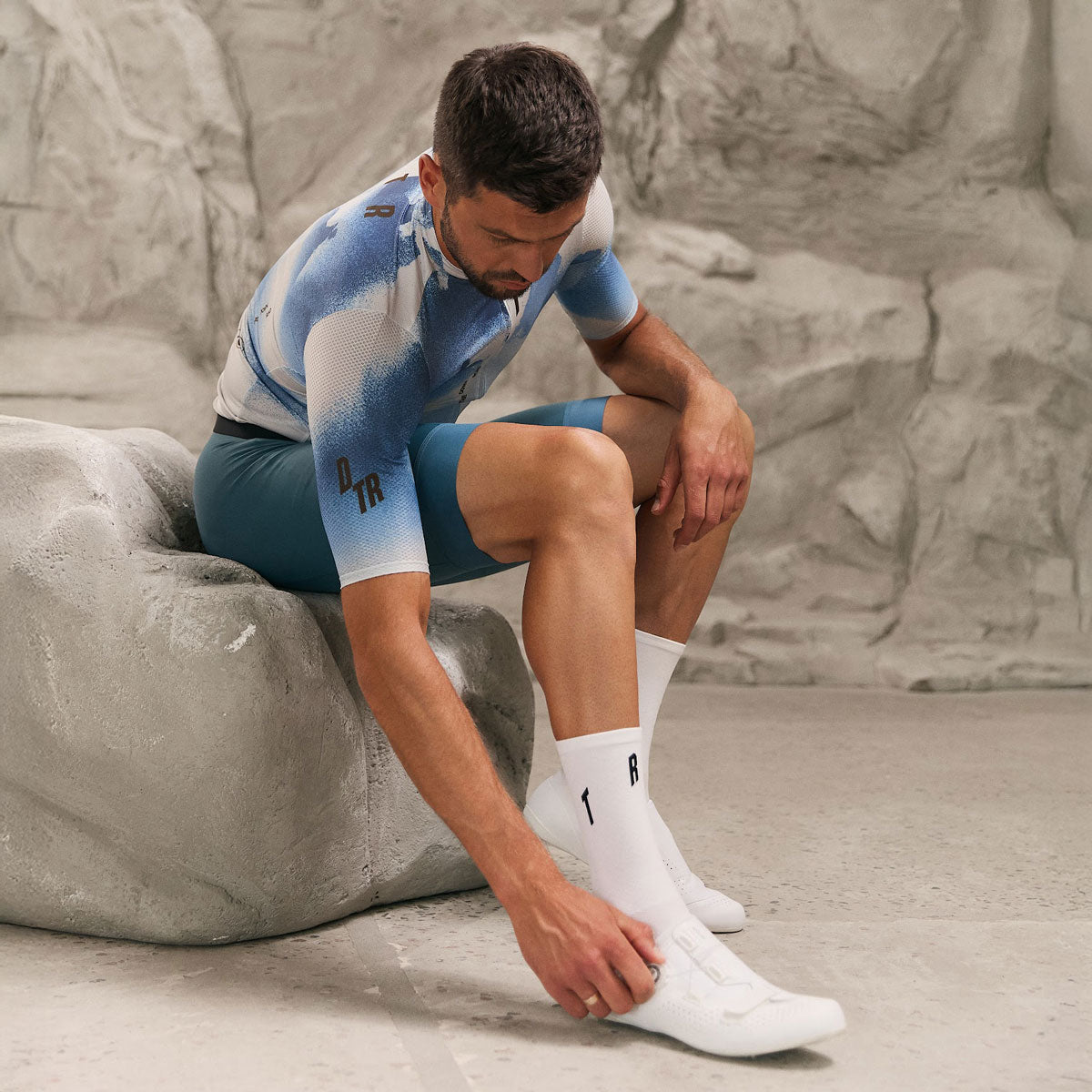
Women's cycling clothing is engineered around a different chamois shape, a shorter torso and a strap layout that works with a bust — it is not a scaled-down version of the men's kit. This guide covers what actually changes in each piece, how the sizing works, and what to buy in what order.
What's actually different in a women's cut?
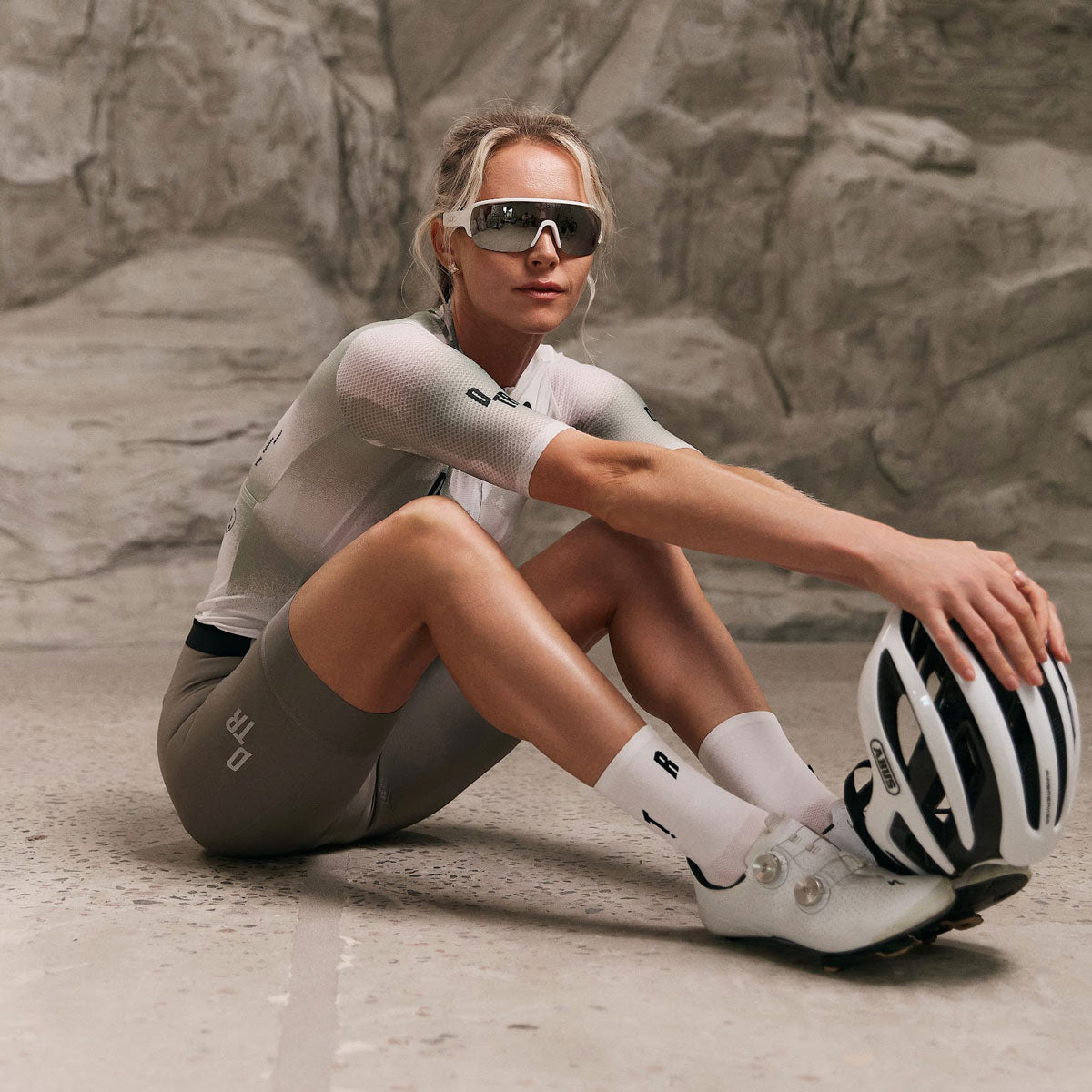
Four things change. The chamois is shaped for female anatomy, with a wider and shorter contact area. The torso is shorter and the waist narrower. Jersey and bib panels allow for a bust without dragging on the zip. And shoulder straps sit narrower, routed to clear the chest rather than cut across it.
What does not change is the specification. Same four-way stretch fabric, same flatlock seams, same multi-density chamois construction. A women's cut is a pattern decision, not a spec downgrade — the panels move, the standard does not.
Bib shorts: the chamois and the strap problem
A women's chamois is shorter front-to-back and wider through the sit-bone area, because female sit bones sit further apart and the pressure map on a saddle is different. Multi-density means the pad varies in firmness across zones — denser where the load sits, softer at the edges. More density is not more thickness.
Straps are the other half of the problem. Set too wide and they slide off the shoulder; set too narrow and they pull across the chest on every pedal stroke. A well-cut women's bib routes the straps closer together over the shoulder and lets them spread across the back, so the short is held up without anything pressing where it shouldn't.
Leg length is worth thinking about separately. A longer leg with a wide silicone gripper holds position better over four hours than a short leg that has to grip harder to stay put. If the gripper is leaving a deep mark, the short is too small, not too long.
The detail is covered properly in our women's bib shorts guide.
How should a jersey sit?
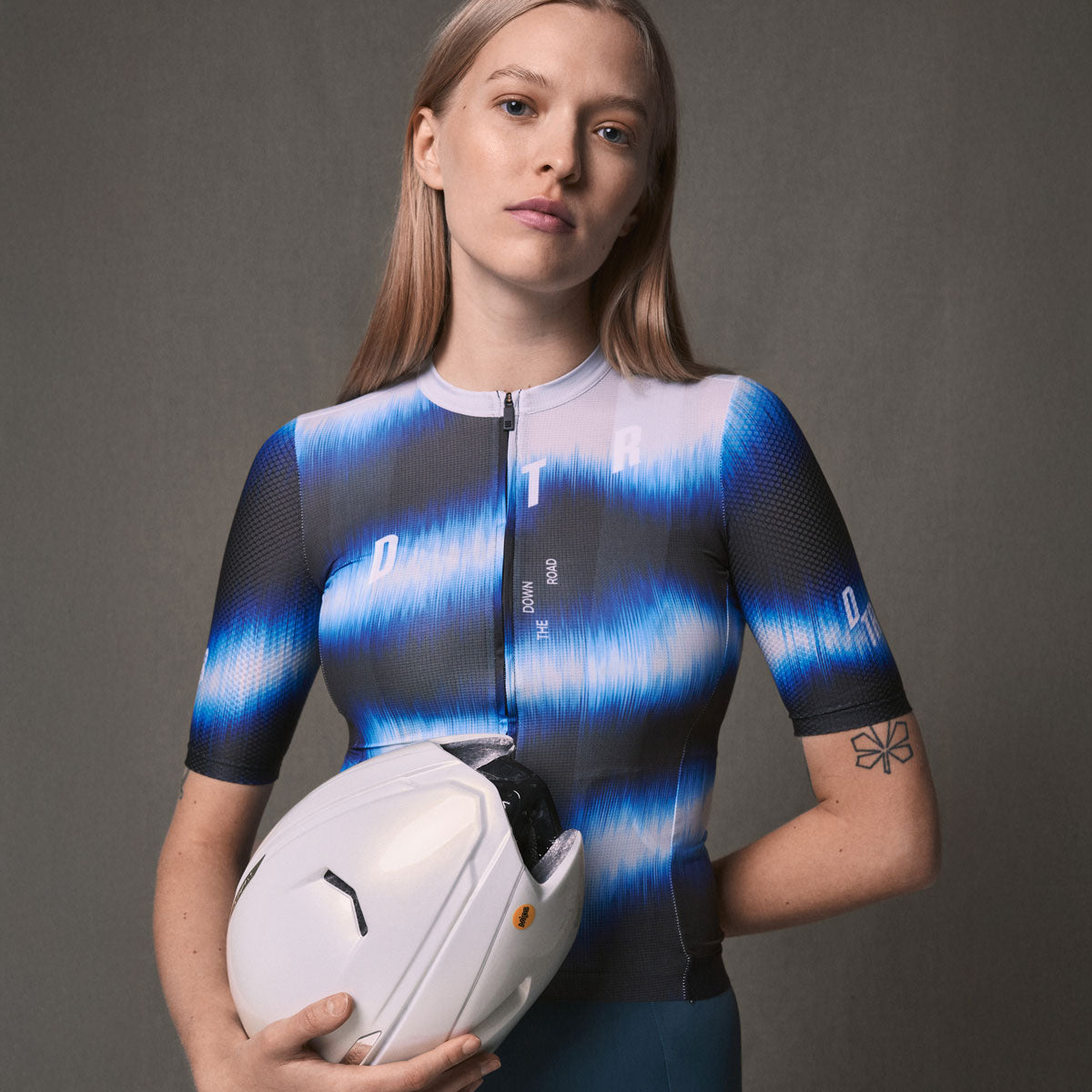
A race-fit jersey should be close through the chest and back with no loose fabric flapping, and the hem should stay put when you are down on the drops. On a woman's frame that usually means a shorter front hem, a longer tail, and a waist that draws in rather than running straight down from the chest.
The common failure is a jersey sized up to fit the bust, which then leaves the waist and arms baggy. The fix is a pattern with the shaping built in, not a bigger size. Check the zip: it should run flat and vertical. If it curves outward at the chest, the panel is wrong for you.
Rear pockets should sit above the saddle line and hold weight without sagging into your ride. More on cut and sizing in our guide to women's cycling jersey fit.
Racing long in one piece: trisuits
A trisuit has to swim, ride and run, so the pad is thinner than a bib short chamois — enough support for the bike leg, thin enough that it does not hold water or chafe on the run. Women's trisuits add a supportive front panel and a leg length that stays down through the run without riding up.
Sleeved or sleeveless is a race-condition decision rather than a fit one: sleeves help in sun and at speed, sleeveless is cooler in humidity and quicker through T1. Either way, the fit should be firm everywhere with no rucking at the lower back when you get on the aero bars.
See our women's trisuit guide for sizing and distance-by-distance pad thickness.
Base layers, warmers and the pieces in between
A base layer's job is to move sweat off the skin, not to add warmth — which is why it earns its place in summer as well as winter. A women's base layer is cut close through the torso with the same shaping logic as a jersey, so it sits flat under a race-fit top rather than bunching.
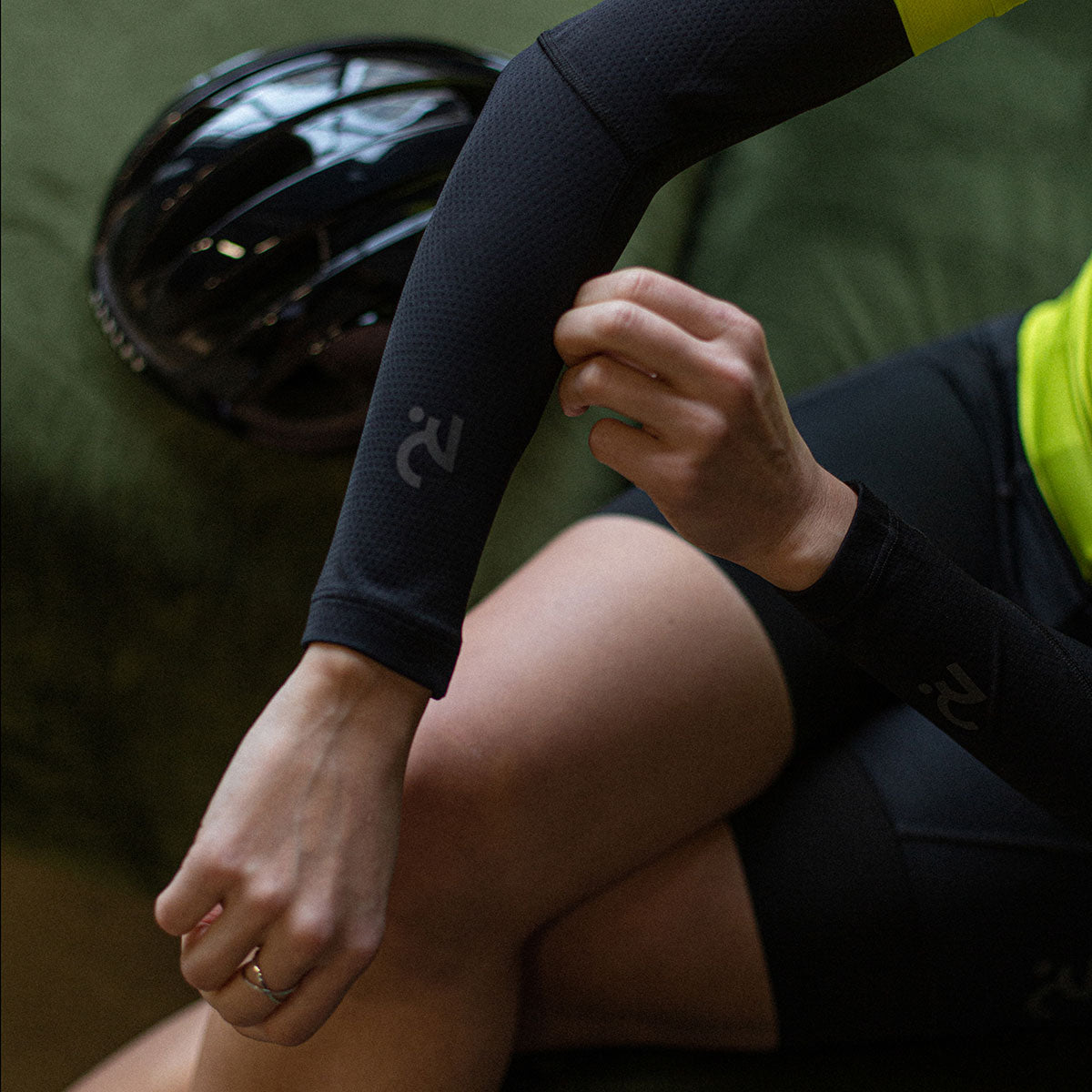
Arm warmers and leg warmers do the rest. Between roughly 8°C and 16°C, bib shorts plus leg warmers cover more ground than thermal bib tights, and they come off at the first climb. Below about 8°C, switch to thermal bib tights. A gilet handles the same job on your torso for descents and early starts.
What size should you buy?
Measure chest, waist and hip, and buy to the chart rather than to the size on your everyday clothes — cycling kit is cut close and the numbers rarely line up. If you fall between sizes, size down for jerseys and trisuits, size up for bib shorts if the leg gripper feels tight.
Two practical checks. Bib shorts should feel firm standing up and disappear once you are on the bike; if they feel comfortable standing still, they are probably too big and will move under you. A jersey should feel snug at the chest with the zip fully closed and free through the shoulders when you reach forward.
Our full cycling kit sizing guide walks through the measurements.
What to buy first
Start with bib shorts. They are the single piece that decides whether a three-hour ride is enjoyable, and no jersey will make up for a chamois that does not suit you. Then a jersey that fits properly, then a base layer, then arm and leg warmers to extend the range of both.
After that, buy against the rides you actually do. Long summer days point to a second set of bib shorts. Early starts and mountain descents point to a gilet. Racing triathlon points to a trisuit rather than a two-piece.
FAQ
Do you wear underwear under women's bib shorts?
No. The chamois is designed to sit directly against the skin. Underwear adds seams, holds moisture and is the fastest route to chafing on a long ride.
Are women's bib shorts just smaller men's shorts?
No. The chamois shape, torso length, strap routing and panel layout are all different. A men's short scaled down would put the pad in the wrong place and the straps in a worse one.
How tight should women's cycling kit be?
Close enough that nothing flaps and nothing shifts, loose enough that you can breathe fully and reach forward without the fabric pulling. Bib shorts should feel firmer than a jersey.
Can you wear a bra under a cycling jersey?
Yes, and most riders do. A seamless sports bra sits best under a race-fit jersey. A base layer over the top helps with sweat management on long or hot rides.
How long do women's bib shorts last?
Roughly 8,000 to 15,000 km with regular washing, depending on use. The chamois usually gives out before the fabric does — when the pad stops recovering its shape overnight, it is done.
See the full women's range at /collections/womens-cycling-triathlon-apparel.
DTR — performance cycling and triathlon apparel, designed and developed in Ukraine.

Leave a comment
This site is protected by hCaptcha and the hCaptcha Privacy Policy and Terms of Service apply.