

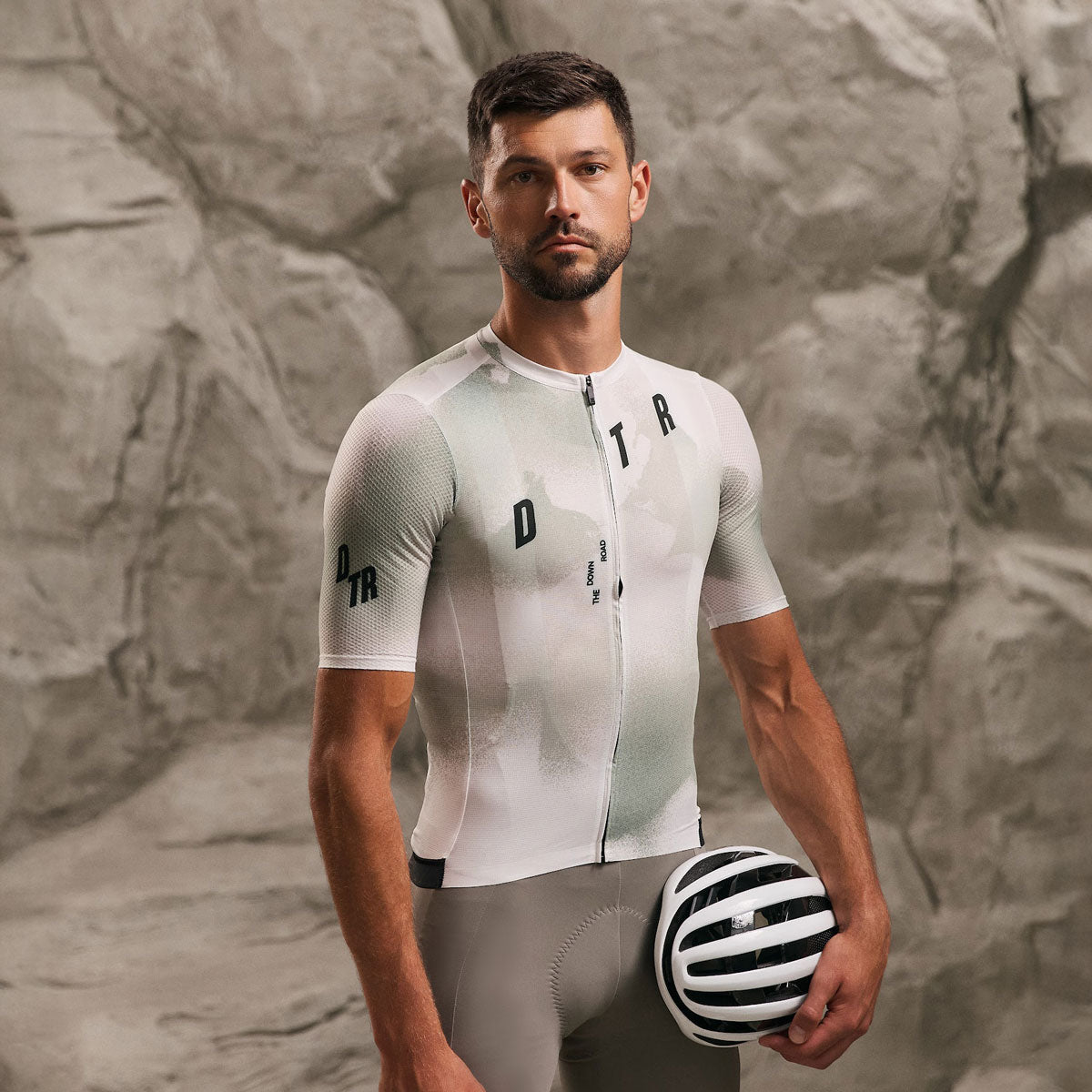
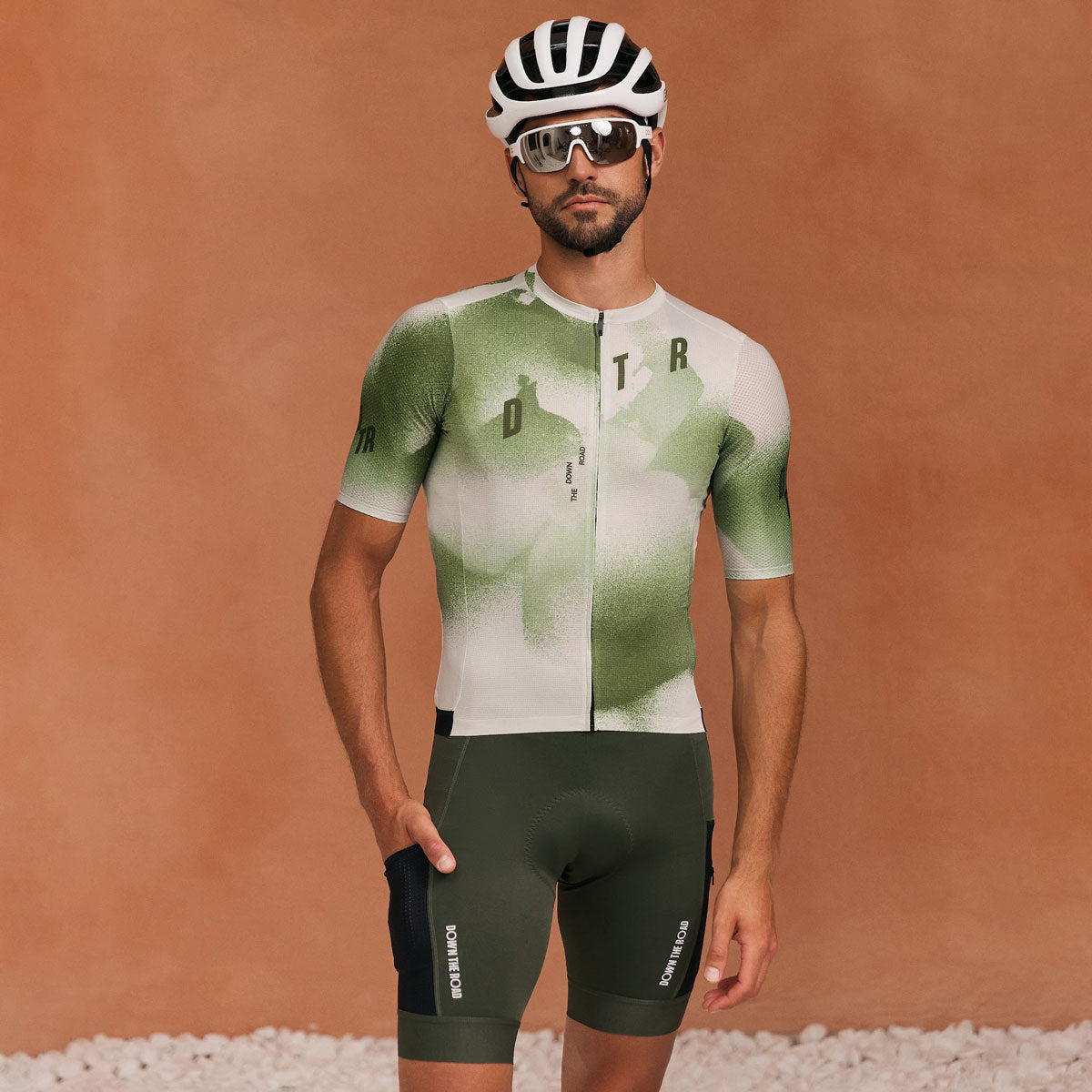
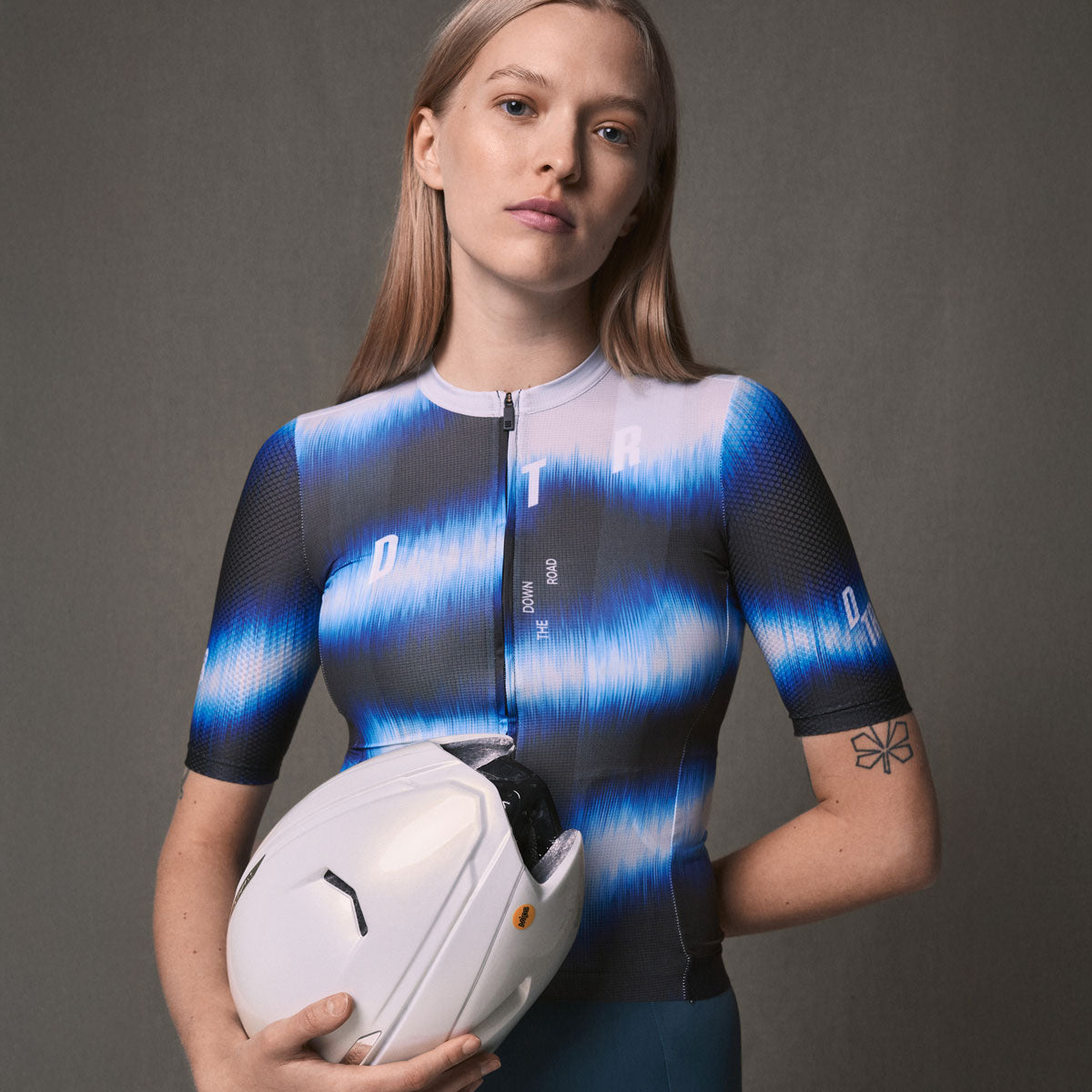

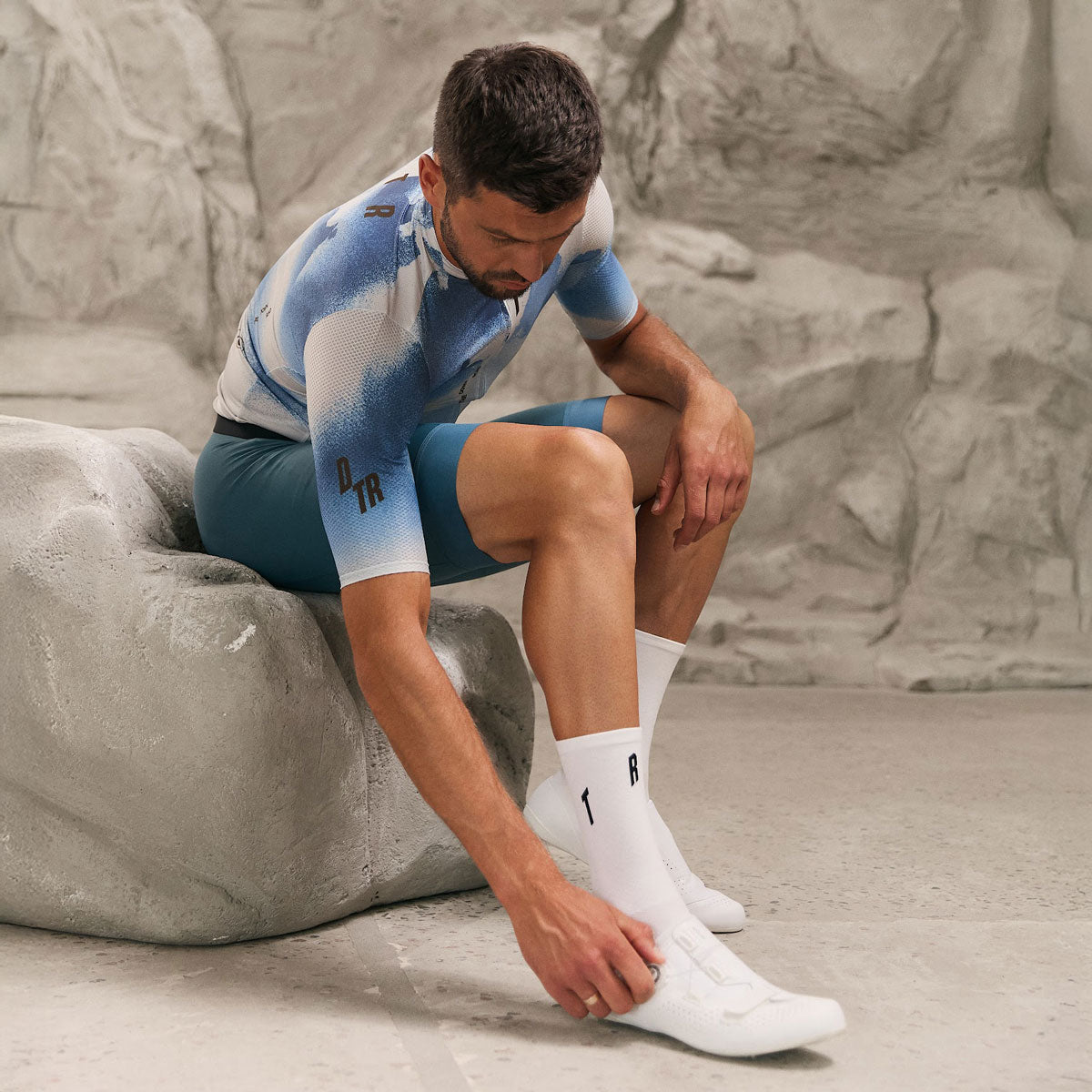
A women's cycling jersey is patterned to a different set of proportions — a shorter torso, narrower shoulders, a different waist-to-hip ratio — and on a well-made jersey those changes are built into the pattern rather than scaled down from the men's version. This guide covers what actually differs, how to judge the fit in the position you ride in, and when a size up is the right call.
What a women's cut actually changes
Four things change. The torso is shorter between the shoulder seam and the hem. The shoulders are narrower and the armholes are set further in. The front panels are shaped through the chest so the fabric lies flat instead of pulling sideways. And the hem is cut for a wider hip relative to the waist. Sleeve circumference usually narrows too.
None of that is cosmetic. Each change removes a specific failure: a long torso bunches at the front when you fold forward, a wide armhole drags fabric across the shoulder blade every pedal stroke, and an unshaped chest panel pulls the front hem upward the moment you reach for the bars.
Why a jersey that fits standing up can still be wrong
A jersey is patterned for a rider bent forward with arms extended, not for someone standing in front of a mirror. In that position the back lengthens by several centimetres, the front shortens, and the shoulders roll forward. A jersey that feels correct standing will often ride up at the back and gather at the front once you are actually on the bike.
Check it in position. Get on the bike, or bend forward and reach out as if holding the hoods. The back hem should still cover you. The front should sit flat without a fold above the waistband. The sleeves should stay put rather than creeping toward the elbow.
Shoulders and armholes: the fit most people get wrong
Shoulder and armhole fit decides more about comfort than chest measurement does. The seam should sit at the edge of your shoulder, not partway down the upper arm. The armhole should clear your armpit without cutting in, and you should be able to reach forward and rotate your shoulders without the whole jersey shifting across your back.
If reaching for the bars drags the hem upward, the armhole is too low or too wide. Sizing up rarely fixes this — a larger size adds width everywhere, including where the jersey already fits. It is a pattern problem, not a size problem, which is why a properly cut women's jersey is worth more than a smaller men's one.
Where the hem should sit, front and back
The back hem should sit low enough to stay covered in the riding position, held by a silicone gripper that grips without digging in. The front should be shorter — a cut-away front hem stops fabric folding over itself where your body compresses when you fold forward. Loaded rear pockets should not drag the hem down your back.
A gripper that rolls or leaves a deep mark is usually a sign the jersey is a size too small through the hip, not that the gripper is wrong.
Race fit, or a size up?
A race-fit cut is close to the body with no loose fabric to flap at speed, and it is the right choice if you race, ride fast group rides, or simply dislike movement in the fabric. It should feel snug standing and correct in position — not restrictive when you breathe deeply.
Size up if you plan to layer a base layer and a thermal layer underneath through winter, if you want rear pockets to carry a full day's food without tension across the back, or if a close cut across the chest and shoulders makes you ride tense. There is no performance penalty worth a jersey you fidget with for four hours.
Fabric behaves differently on a closer cut
The closer the cut, the more the fabric has to do. A four-way stretch technical lycra moves with the shoulder and returns to shape; a fabric that only stretches across the body will pull at the armhole as you reach forward. Flatlock seams matter more on a fitted jersey too, because the seam sits directly against skin rather than floating inside loose fabric.
Panel construction is where a women's jersey earns its keep. More panels mean more places to shape the garment — through the chest, at the waist, over the hip — which is how a fitted jersey stays flat instead of gathering.
FAQ
Is there really a difference between men's and women's cycling jerseys?
Yes. The torso is shorter, the shoulders and armholes are narrower and set differently, the front panels are shaped through the chest, and the hem is cut for a different waist-to-hip ratio. A women's jersey is a separate pattern, not a smaller men's jersey.
Should a women's cycling jersey be tight?
It should be close, not tight. Snug enough that nothing flaps at speed, loose enough that you can breathe deeply and reach the bars without the hem lifting. If it restricts your ribs or drags across your shoulders when you reach, it is too small.
How do I know what size to order?
Measure your chest and hips rather than working from your usual clothing size, and check both against the size chart — cycling sizing runs closer than high-street sizing. If you sit between two sizes, the deciding factor is what you plan to wear underneath.
Can I wear a base layer under a fitted jersey?
Yes, and you should. A lightweight base layer moves sweat off the skin and adds almost no bulk. If you ride in a thermal base layer through winter, factor that in when choosing your size. The same engineered-not-scaled logic applies underneath — see how a women’s base layer should fit.
What about sleeve length?
Sleeves on a race-fit jersey sit mid-bicep and stay there, held by a gripper or a bonded hem. If they ride toward the elbow when you reach forward, the sleeve circumference is too wide for your arm rather than the sleeve being too short.
See the women's jersey range at /collections/women-jerseys.
DTR — performance cycling and triathlon apparel, designed and developed in Ukraine.

Leave a comment
This site is protected by hCaptcha and the hCaptcha Privacy Policy and Terms of Service apply.