

For a long descent the layer that matters is a windproof one over a dry torso — a packable windbreaker or vest you can pull on in ninety seconds at the summit, plus arm warmers and something under the helmet once the drop is over 1,000 metres. Everything else is detail.
This guide covers what to carry on big mountain days, when to add layers rather than what to buy, and how to manage the 20-degree swing between a 40-minute climb and the descent that follows it.
Why you freeze on the way down
You freeze because you stop making heat and start losing it fast. Climbing, your body produces several hundred watts of waste heat and you shed it by sweating. Descending, you produce almost nothing while moving through air at 50–70 km/h across skin and fabric that are still wet. Air temperature falls roughly 6°C per 1,000 metres on top of that.
The numbers stack in a way that surprises people the first time. A 24°C valley start becomes about 15°C at 1,500 metres. Add 60 km/h of apparent wind to damp fabric and the effective temperature on your chest is nearer 5°C. You did not get unlucky with the forecast — you rode into a different climate and stopped heating yourself at the same moment.
What to carry for a 1,500-metre day
Three items cover almost every summer alpine day: a packable windbreaker, arm warmers, and a cap or headband under the helmet. Together they weigh under 250 grams, fit in one jersey pocket, and take the descent from painful to comfortable. Everything beyond that is weather-specific.
- Windbreaker or vest. The windbreaker seals the arms as well as the torso; the vest keeps the arms free and vents better if you are climbing again within the hour. On a day with one big summit, take the windbreaker. On a day with four rolling cols, the vest usually wins.
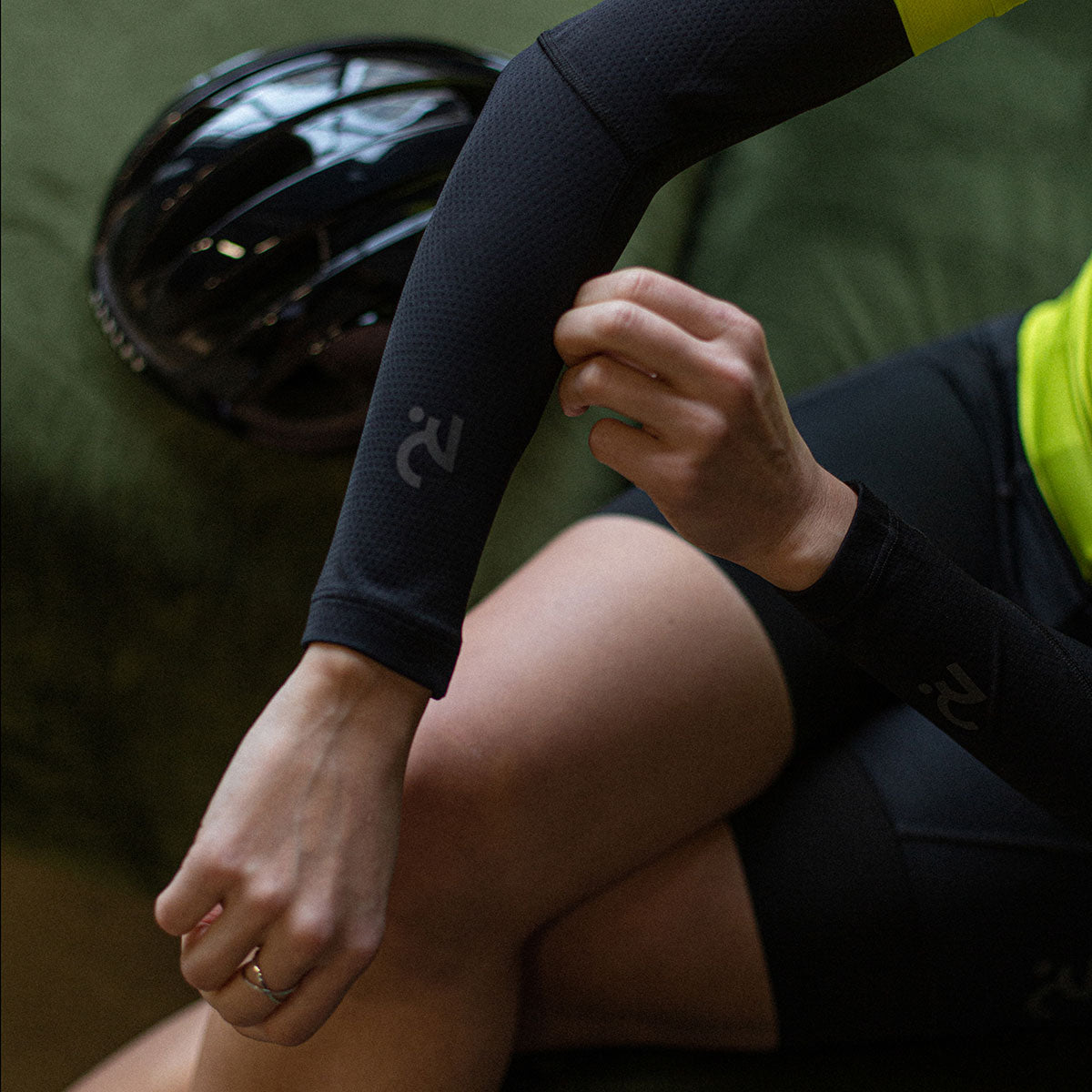
- Arm warmers. On and off in seconds without removing anything else. They also cover the gap a vest leaves.
- Headwear. A cap under the helmet cuts the wind through the vents; a headband covers the ears specifically. Ears are the first thing to hurt at speed.
- Leg warmers, if the summit is above 2,000 metres or the start is before 8am. Knees stiffen quickly in cold air, and a stiff knee on a technical descent is a handling problem, not just a comfort one.
- A second pair of socks in the bag on multi-col days. Dry feet at the top of the last climb are worth the 40 grams.
When to add the layer
Put the layer on at the summit, before you start moving, while you are still warm. A windproof shell traps the heat you already have; it does not create any. Pull it on after two minutes of descending and you are sealing in cold, damp air instead — the layer then feels useless and you blame the layer.
The practical version: stop at the top, unzip fully for thirty seconds to dump the worst of the steam, then close everything and go. Those thirty seconds matter more than the fabric. If there is a café or a hairpin with a view, that is your changing room — riders who descend cold are usually the ones who could not face stopping.
Sweat matters more than air temperature
A dry rider at 6°C is more comfortable than a wet rider at 12°C. Evaporating sweat pulls heat out of you at a rate no shell can offset, which is why the layer you climb in decides how the descent feels. Choose a jersey and base layer that move moisture away fast, then keep the shell in the pocket until the top.
This is the argument for a lightweight base layer in summer, which sounds counterintuitive and is not. A thin technical base layer lifts sweat off the skin and holds it in a layer you can seal under a windbreaker, so the cold air never touches wet skin. A bare torso under a soaked jersey has nothing between it and the wind. See whether you need a base layer in summer for how thin is thin enough.
Warmers give you control a jacket can't
Arm and leg warmers let you adjust in increments rather than all at once. On a day with several cols you will be too warm and too cold repeatedly, and a full jacket is a single on-off switch. Warmers give you four or five useful states between bare arms and fully sealed, all reachable without stopping properly.
The sequence most riders settle on over an alpine week: bare arms climbing, arm warmers pulled up at the summit, windbreaker over the top for the fast section, windbreaker off and stowed at the valley floor, arm warmers rolled to the wrist for the next climb. Nothing comes off over the head, nothing goes in a bag you cannot reach. If you are new to them, the case for arm warmers covers fit and when they earn their place.
What changes on gravel and very long descents
Gravel descents are slower, rougher and longer in elapsed time, which flips the priority from windproofing to durability and carrying capacity. You are moving at 25–35 km/h rather than 60, so chill builds gradually instead of hitting immediately — but you are exposed for far longer, and you cannot take a hand off the bars to fix a flapping layer.
Three adjustments hold up:
- Fit tighter, not looser. A flapping shell on a rough surface is noisy, drags, and catches on hydration hoses. Race-fit outer layers stay put.
- Move the load off your back. Cargo bib shorts take the layer you just removed without unbalancing full jersey pockets on rough ground — see the cargo bib shorts guide.
- Plan for the whole descent, not the first kilometre. A 40-minute gravel descent at altitude will cool you far past what the first two minutes suggest.
On road descents over 20 minutes — long alpine passes, big gran fondo courses — treat the descent as its own segment with its own kit, the same way you would treat a time trial. Our gran fondo kit guide covers the same logic across a full event day.
Frequently asked questions
Do I need a full jacket or is a vest enough?
A vest is enough when the descent is under ten minutes or the valley temperature is above 18°C. Above 1,500 metres, on descents over ten minutes, or when you are already wet, the sealed arms of a windbreaker make a noticeable difference. Many riders carry the vest and add arm warmers to cover the gap.
Does stuffing newspaper down the front of your jersey actually work?
It works, and it worked for the same reason a windbreaker does — it is a windproof barrier over the chest. It is genuinely useful if you are caught out without a layer. It is not a plan, because it does nothing for your arms, it disintegrates in rain, and it will not survive a second descent.
How cold does it get on a descent compared to the valley?
Assume roughly 6°C lost per 1,000 metres of altitude, then subtract more for wind chill at speed. A 1,500-metre descent starting from a 24°C valley typically feels like riding at 3–8°C, and colder still if your jersey is wet.
Should I stop to put layers on, or do it rolling?
Stop. Arm warmers can be managed rolling if you are confident, but a windbreaker cannot, and the thirty seconds you spend venting steam at the summit is the single highest-value thing you will do for the descent.
What about my hands and feet?
Extremities cool fastest because blood flow to them drops when your core is working to stay warm. If your hands or feet go numb regularly on descents, that is usually a sign the core layer underneath is wet rather than a sign you need thicker extremity kit — fix the torso first.
Build the layer system: the DTR windbreaker, vest and warmer lineup is at Arm & Leg Warmers.
DTR — performance cycling and triathlon apparel, designed and developed in Ukraine.

Leave a comment
This site is protected by hCaptcha and the hCaptcha Privacy Policy and Terms of Service apply.