


In strong wind, wear a windproof outer layer over a thin warm one rather than one thick jersey — a gilet or windbreaker over a base layer and jersey will keep you warmer than a heavier top with no wind protection. This guide covers how much colder wind makes a ride feel, what to wear at different speeds, and what changes when the wind is across you rather than into you.
Why wind is its own variable
Air moving across you strips heat away far faster than still air, and it forces its way through any fabric that is not built to stop it. That is why a 12°C day with a 40 km/h wind feels colder than a still 6°C day, and why the thickest jersey in your drawer is the wrong answer if the wind goes straight through it.
It also compounds with your own speed. Riding at 30 km/h into a 30 km/h headwind means 60 km/h of air over your chest, which is why descents and headwind sections are where people get cold rather than the climbs in between. The layer that matters is the one on the outside.
How much colder does it actually feel?
As a working rule, drop your effective temperature by around 5°C in a moderate wind and closer to 8–10°C in a strong one, then dress for that number rather than the one on the forecast. A 14°C day in a stiff wind should be dressed as a 5°C day on the exposed sections.
The effect is not even across your body. Your chest, the fronts of your thighs and the backs of your hands take almost all of it, while your back stays comparatively warm. That is exactly why a gilet works so well: it covers the surface doing the cooling and leaves the rest to breathe.
Our temperature guide gives the baseline layers by degree — on a windy day, read it one band colder than the thermometer says.
What to wear when it is blowing
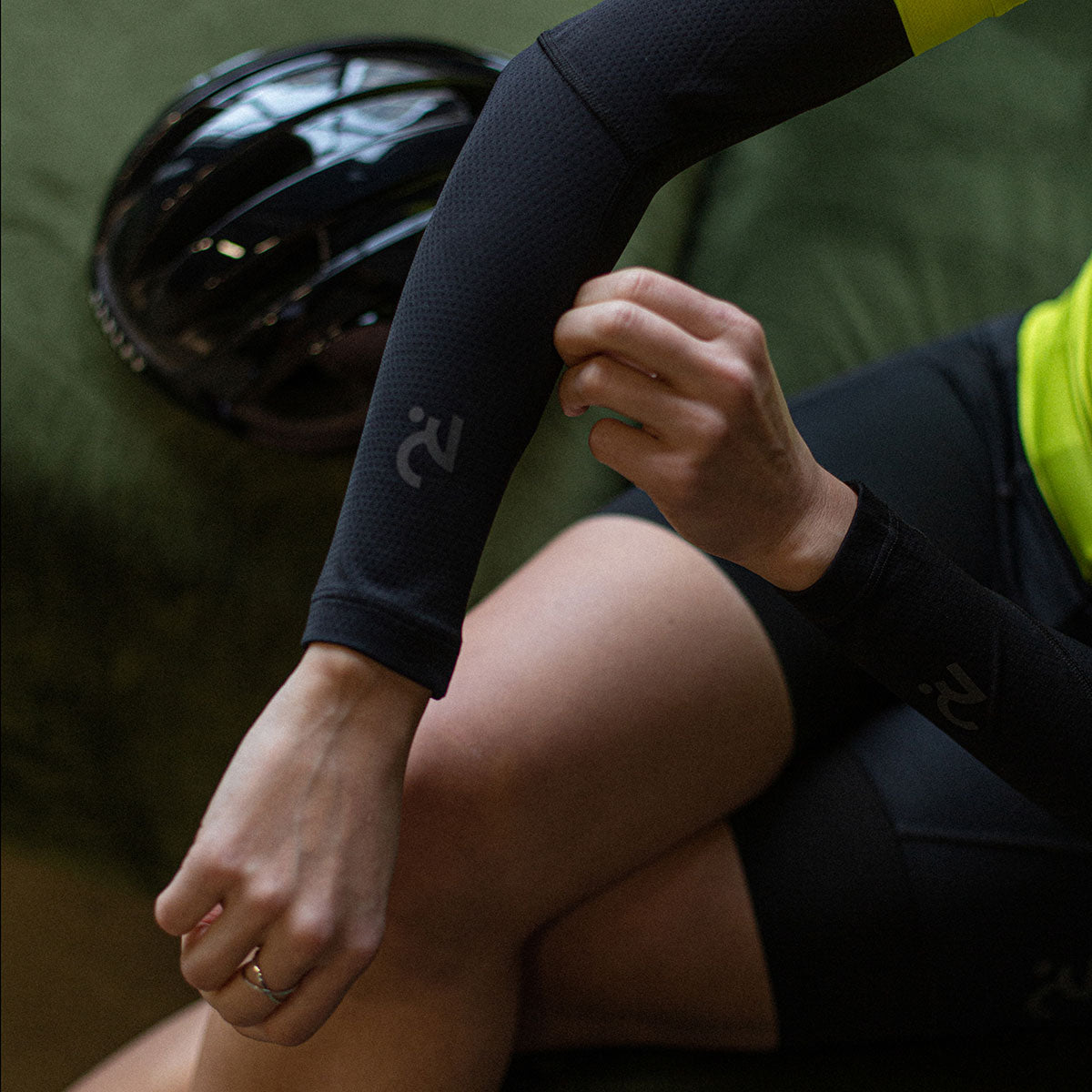
Above roughly 15°C, a jersey and bib shorts with a packable gilet is usually enough; the gilet goes on for the exposed sections and back in a pocket on the sheltered ones. Between 8°C and 15°C, add arm warmers and a windbreaker rather than a heavier jersey. Below 8°C, thermal bib tights, a long sleeve thermal jersey and a windproof outer layer.
The principle underneath all three is the same: block the wind on the outside, then insulate underneath as thinly as the temperature allows. A windproof shell over a light layer is warmer, more adjustable and more packable than a single thick garment, and you can shed it at the turnaround when the headwind becomes a tailwind.
A gilet and a windbreaker do the same job at different intensities. A gilet blocks the chest and leaves the arms free, which suits changeable days and hard efforts. A windbreaker adds sleeves for genuinely cold or wet wind. Our windbreaker guide covers where the line falls between them.
The parts that get cold first
Hands, knees and feet lose out before your torso does, because they are furthest from your core and sit directly in the airflow. Full-finger gloves come out earlier on a windy day than the temperature alone would suggest, and knees are worth covering below about 15°C when the wind is up.
Feet are the ones people leave too late. Overshoes or even a thin windproof cover across the top of the shoe make a large difference, because a ventilated road shoe is designed to let air through and does exactly that. Ears are the other overlooked one — a thin headband under the helmet costs almost nothing to carry.
Headwind, crosswind and tailwind days
A crosswind is the one that changes how you ride rather than what you wear. It pushes on your whole side profile, which makes deep wheels and loose clothing harder to control, and it comes and goes as you pass gaps in hedges, buildings and tree lines. Fabric that flaps in a crosswind is both slower and less predictable.
That is a practical argument for a close-fitting outer layer with an elasticated hem and cuffs. A flapping shell in a gusting crosswind is genuinely distracting, and it is the main reason a cycling-specific windbreaker beats a general outdoor jacket — the cut is designed to stay still in the riding position.
On an out-and-back route, plan the outbound leg into the wind and the return with it. It is the standard approach for good reason: you get the hard work done fresh, and the tailwind home stops you sitting in wet kit at low effort with nothing to warm you up.
Is riding in strong wind dangerous?
Strong wind is a handling issue more than an exposure one. The risks are being pushed off your line by a gust, debris coming down on wooded or tree-lined roads, and reduced control on descents where you are already going fast and light on the bars.
Practical adjustments: ride on the hoods rather than the drops in gusts so you can react, hold a wider line away from the verge, ease off on exposed descents, and avoid tree-lined roads in the strongest conditions. If gusts are strong enough to move you across your lane, a shorter sheltered loop or an indoor session is the reasonable call rather than a badge of honour.
Wind with rain
Wind and rain together are the hardest combination to dress for, because a wet windproof layer conducts heat away rather than trapping it. A dedicated waterproof outer layer matters more than usual here, and a windbreaker with light water resistance is not a substitute in sustained rain.
Underneath, the base layer earns its place. Wet fabric against the skin in moving air is the fastest route to getting genuinely cold, and a technical base layer keeps a moving layer of moisture off you. Our guide on what to wear cycling in the rain covers the wet-weather side in full.
Frequently asked questions
What wind speed is too windy to cycle?
There is no single number, but most riders find sustained winds above about 40 km/h hard work and gusts above 55–60 km/h genuinely difficult to hold a line in. Gust strength matters more than average speed, because it is the sudden change that moves you.
Does a windbreaker actually make a difference?
Yes, and more than an equivalent weight of insulation. Stopping air movement across the skin is what keeps heat in, so a very light windproof layer over a thin jersey usually beats a much heavier jersey worn alone.
Should you wear a gilet or a jacket in the wind?
A gilet above roughly 12°C, or when you expect to work hard and want the arms free. A windbreaker below that, or when the wind is cold or carrying rain. Both should be close-fitting so they do not flap.
Does cycling into a headwind burn more calories?
For a given distance, yes — you are pushing against more air resistance, so the effort at the same speed is considerably higher. For a given time at a given power, no. It is the same work rate, just at a lower speed.
How do you dress for a windy descent?
Put the outer layer on before the descent, not partway down. You generate almost no heat descending and the airflow is at its highest, so a gilet that was surplus on the climb becomes the difference between comfortable and cold within a couple of minutes.
Find a layer that stops the wind: /collections/windbreakers.
DTR — performance cycling and triathlon apparel, designed and developed in Ukraine.

Leave a comment
This site is protected by hCaptcha and the hCaptcha Privacy Policy and Terms of Service apply.