

Fluorescent colour and retroreflective material are two different technologies solving two different problems. Fluorescent works in daylight and fails at night; retroreflective works in headlights and does nothing in daylight. A garment that does one well often does the other badly, and knowing which problem you actually have decides what to buy.
This guide covers how each one works, where reflectivity needs to sit to be useful, why movement matters more than surface area, and how to add visibility to kit you already own — plus what clothing genuinely cannot fix.
Daylight and darkness are different problems
Fluorescent fabric absorbs invisible UV and re-emits it as visible light, which is why fluorescent yellow looks impossibly bright on a grey afternoon. Retroreflective material bounces light straight back toward its source, so it only lights up when a headlight hits it. Neither substitutes for the other.
The practical consequence is that a fluorescent jacket is close to useless at 10pm on an unlit road, and a black jacket covered in retroreflective piping is close to useless at 2pm. Most riders own one and assume they are covered for both, which is where the gap opens up.
Dusk is the hardest case, because UV levels have dropped so fluorescence is weakening, while ambient light is still bright enough that headlights are not yet doing much work. If you ride one time of day where visibility matters most, it is the hour either side of sunset — and that is the case for having both.
Where reflectivity needs to sit
Reflectivity is only useful where a driver's headlights can hit it and where a driver is actually looking. A reflective panel across your upper back is visible to the car directly behind you and to nobody else, which leaves your two most dangerous angles — side-on at junctions and three-quarter rear — uncovered.
The positions that earn their place:
- Ankles and feet. The single highest-value location, for reasons covered below. Reflective socks, overshoe strips, or ankle bands.
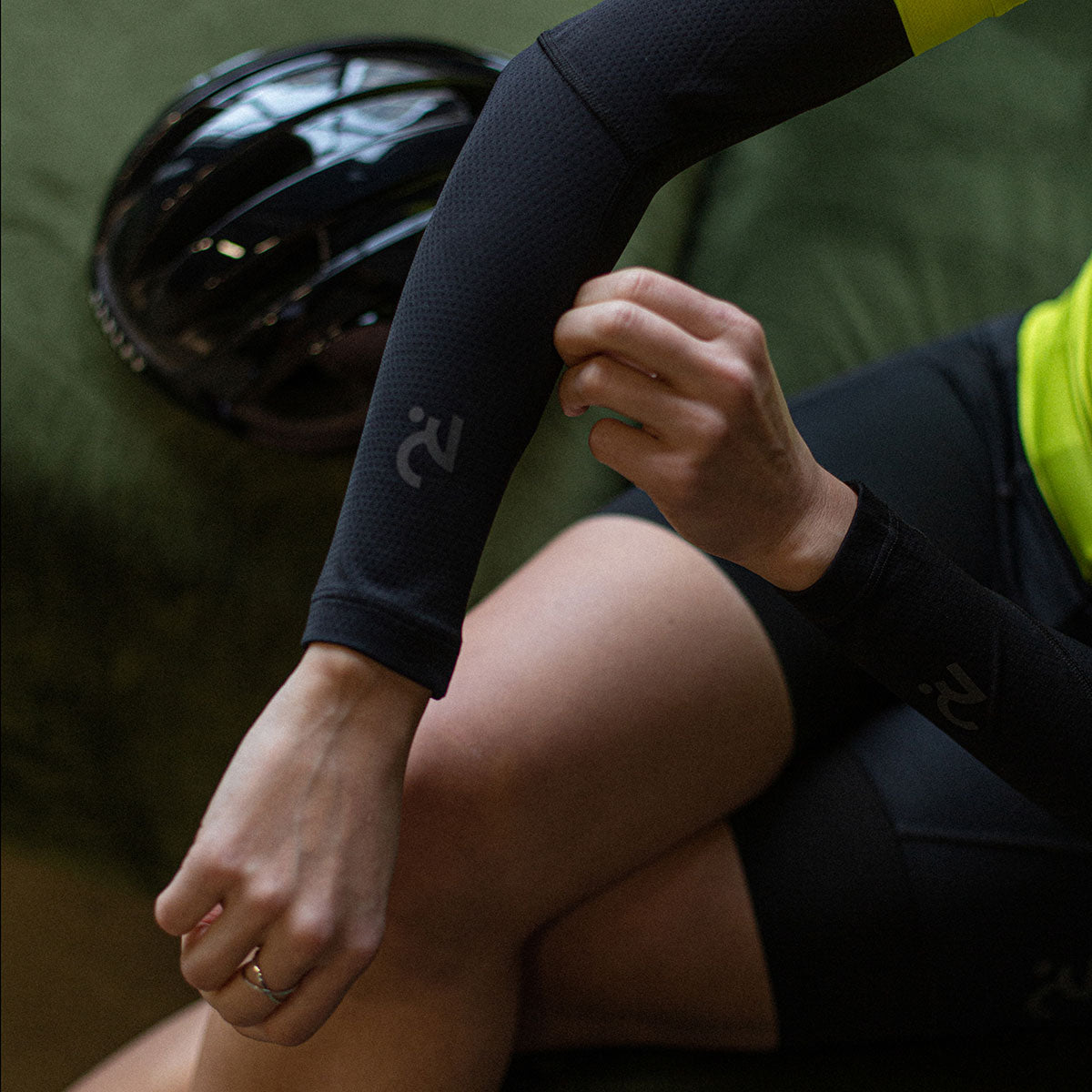
- The side of the body. Sleeves, the outside of the thigh, and the sides of shoes. This is what makes you visible at a junction, which is where a large share of urban collisions happen.
- The moving parts of the leg. Knee and lower thigh, visible in the pedal stroke.
- Upper back and shoulders. Useful, but the least valuable of the four despite being where manufacturers put most of it.
Height matters too. Reflective material low on the body catches dipped headlight beams, which point down at the road; material high on the back is often above the main beam at close range.
Why moving parts beat big panels
Human vision detects biological motion far faster than it detects shape or brightness. Reflective material on your ankles, knees and heels creates a moving pattern that the brain identifies as a person almost instantly — far faster than a static bright rectangle, which reads as an object.
This is the most useful thing to know about visibility, and it is why a rider with reflective ankle bands is recognised as a cyclist at a greater distance than a rider in a large reflective vest with nothing on the legs. The vest says something is there. The pedalling ankles say a person is there, moving that way, at that speed.
In practice this means reflective socks or ankle bands are the highest return per gram and per euro of anything on this page. They are also the easiest to add to kit you already own.
Building visibility into what you already wear
You do not need a dedicated hi-vis wardrobe. Most riders get most of the benefit by making three choices differently: a bright outer layer for daylight, reflective socks or ankle bands for the dark, and a rear light that stays on in daylight.
How that maps onto real kit:
- The outer layer is where colour matters. Your windbreaker or vest is on the outside and covers the largest area, so its colour does the daylight work. A bright windbreaker over a dark jersey achieves what a bright jersey under a dark jacket cannot. See our windbreaker guide and the case for a cycling vest.
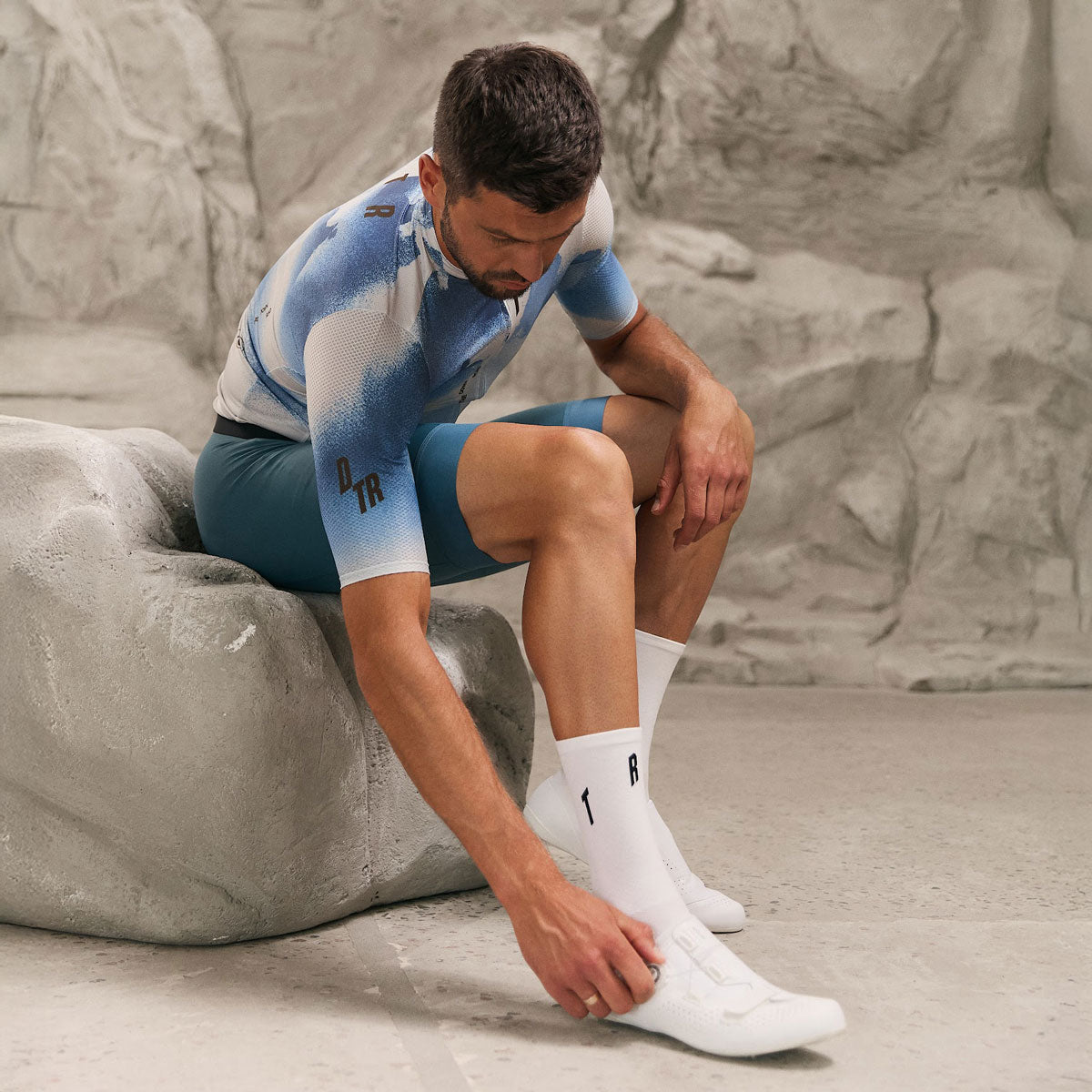
- Socks are the cheapest visibility upgrade you will make. White or bright socks help in daylight; reflective detail helps at night; both sit in the highest-value position on the body.
- Contrast beats colour matching. A rider in all one dark colour reads as a single silhouette. Breaking that up — light jersey, dark shorts, bright socks — makes the human shape resolve faster.
- Keep it on the outside. Reflective detail under a jacket does nothing, and this is the most common way riders accidentally cancel their own visibility.
We do not make dedicated hi-vis safety garments — a certified high-visibility vest is a separate purchase, and if your riding genuinely demands one, buy one. What DTR kit can do is give you a bright, well-fitting outer layer that you will actually wear, which is worth more than a compliant vest left at home.
Fit and flapping matter more than you would think
A loose hi-vis garment that flaps distorts the shape a driver is trying to read, and on a fast road it also slows you down and makes noise that masks traffic. Visibility clothing works best when it holds a clean silhouette, which means fitted rather than baggy.
This is the practical argument against the oversized builder's vest worn over cycling kit. It is very bright and very cheap, and it is also flapping, noisy, and blurring the outline of a moving person into a shifting yellow blob. A fitted bright layer in the same colour does the job better.
What clothing can't do
Clothing helps a driver who is looking in your direction resolve you faster. It does very little for a driver who is not looking, and nothing at all for one whose view is blocked. Treating a hi-vis layer as protection rather than as one input among several is where the thinking goes wrong.
Three things do more than fabric in most conditions:
- Lights, day and night. A daytime running light on the rear is more effective in daylight than any fabric choice, because it is an active light source rather than a passive one.
- Road position. Riding where you can be seen — out of the gutter, out of blind spots, clear of parked cars — changes whether you appear in a driver's field of view at all.
- Predictability. Consistent line, clear signals, no sudden movements. A driver who has seen you needs to be able to guess what you will do next.
For riders doing this daily in traffic, what to wear cycling to work covers the commuting kit picture, and riding in the rain covers the conditions where visibility drops fastest.
Frequently asked questions
Is fluorescent yellow better than white for daylight visibility?
In most daylight conditions, yes — fluorescent yellow-green sits where human vision is most sensitive and it re-emits UV as visible light, so it stands out against grey and green backgrounds that white can blend into. Against snow or a bright overcast sky, the advantage narrows considerably.
Do I need a hi-vis vest, or is a bright jacket enough?
For most riders a bright, well-fitting outer layer plus reflective ankles and good lights covers it. A certified hi-vis vest matters if you ride in professional contexts that require one, or on fast unlit roads with heavy traffic. Fit and consistency of use matter more than certification for everyday riding.
Where should reflective material go on cycling clothing?
Ankles and lower legs first, then the sides of the body, then the upper back. Moving reflective points on the legs are recognised as a person far faster than a static panel, and low placement catches dipped headlight beams that pass under higher material.
Does reflective detail wear out?
Yes. Retroreflective prints and transfers degrade with washing, abrasion and UV exposure, and a faded reflective strip returns much less light than a new one. If a garment's reflective detail looks grey and matte rather than bright silver under a torch, it is doing less than it was.
Should I use lights during the day?
A rear daytime running light is one of the highest-value visibility measures available and is more effective in daylight than any fabric choice, because it emits light rather than reflecting it. Fabric and lights are complementary, not alternatives.
Put the colour where it counts — on the outside: the DTR windbreaker range is at Windbreakers.
DTR — performance cycling and triathlon apparel, designed and developed in Ukraine.

Leave a comment
This site is protected by hCaptcha and the hCaptcha Privacy Policy and Terms of Service apply.