

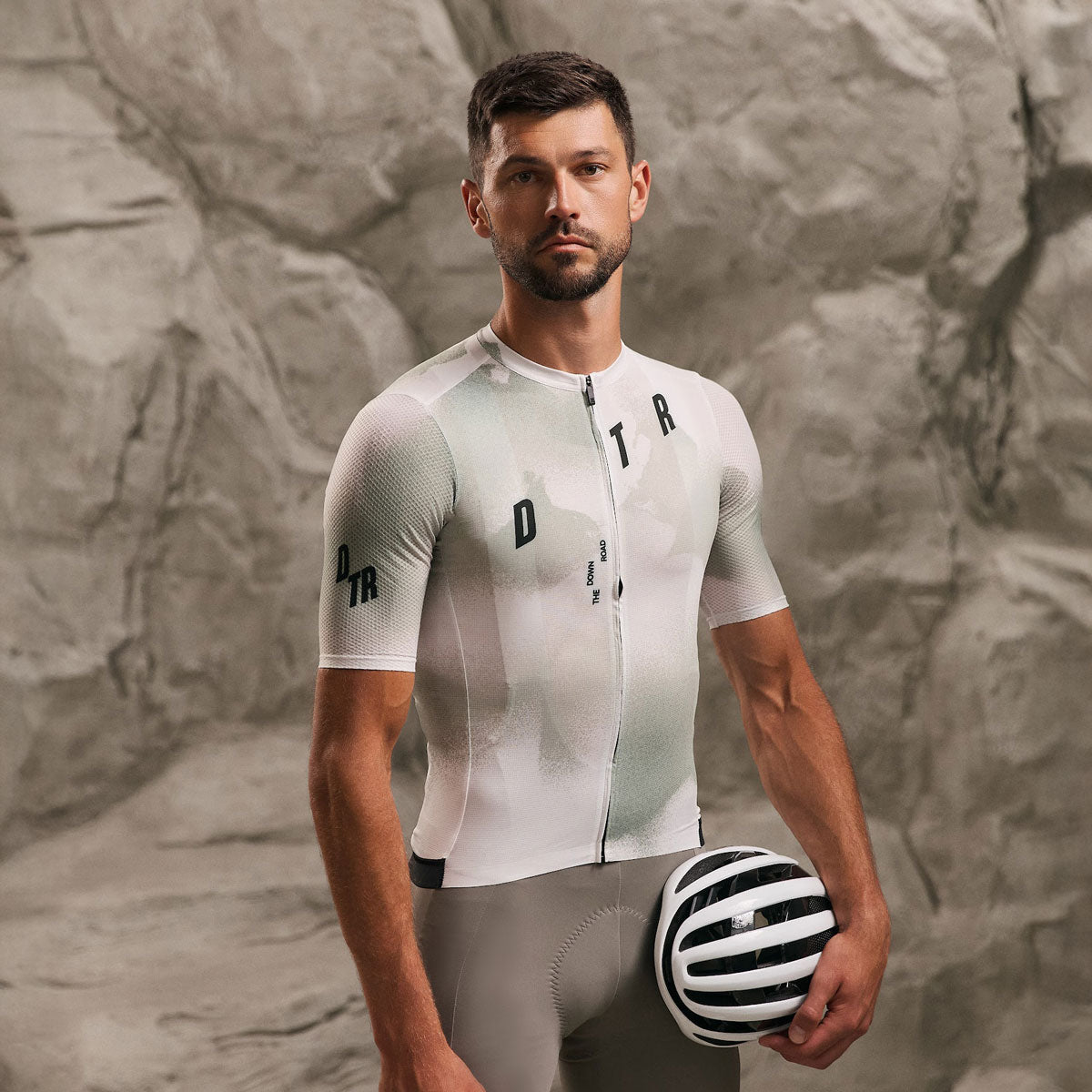
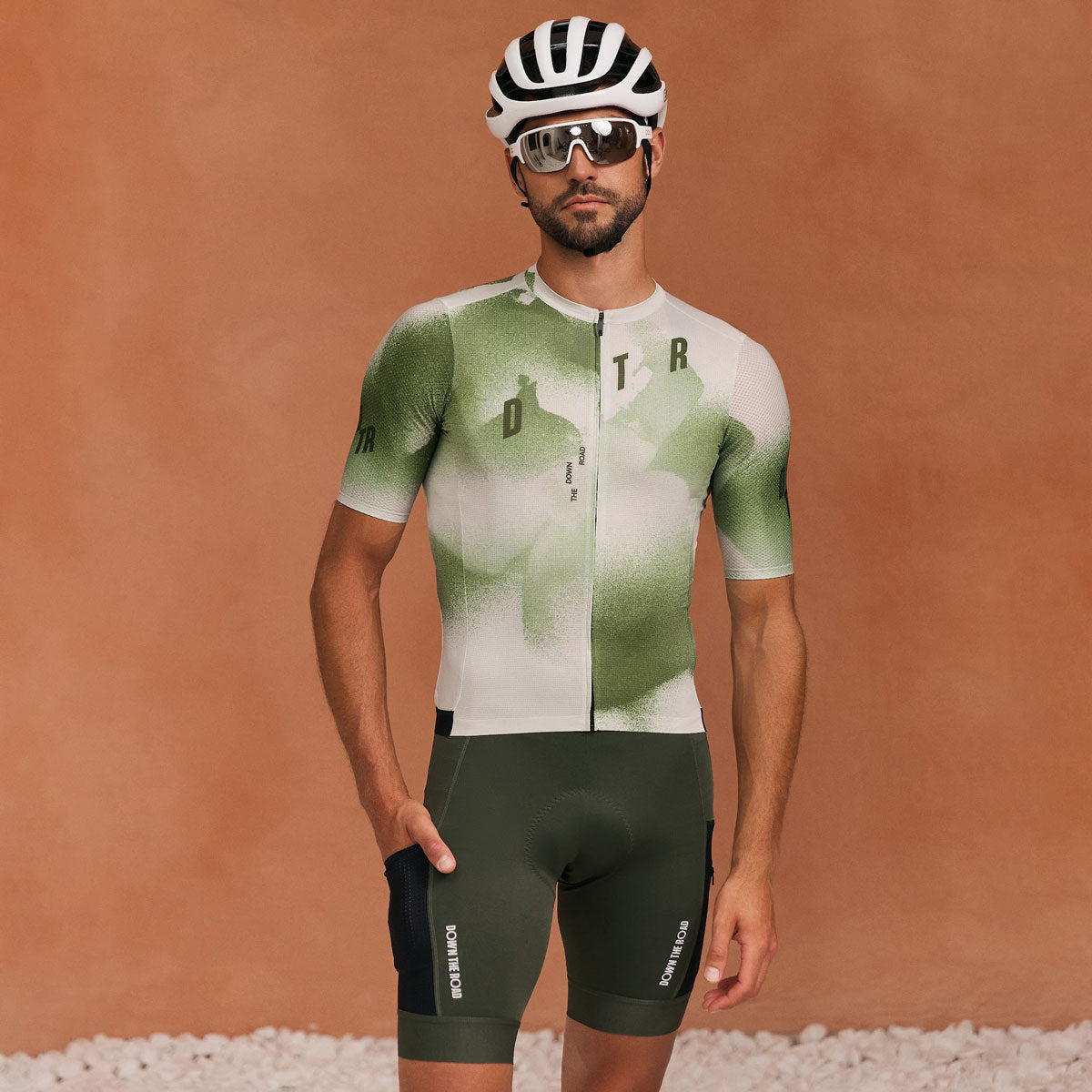


A full-zip cycling jersey opens all the way down the front. A half-zip stops around mid-chest. The practical difference is how fast you can shed heat: a full zip turns the front of the jersey into an adjustable vent you can open by degrees mid-ride, while a shorter zip holds a little more warmth and keeps the front panel smoother.
This guide covers what zip length actually changes on the bike, which one suits which temperature and ride type, and where quarter-zip and zipless jerseys sit.
What zip length actually changes
Zip length controls how much of your chest you can expose while riding. A full-length zip lets you vent by degrees and reverse it one-handed without stopping. A shorter zip gives you a fixed neck opening and little else. Cooling range, reaction speed and how easily the jersey goes on over a base layer all follow from that one variable.
It matters more than most riders expect, because body temperature on a road ride is rarely stable. A twenty-minute climb and the descent that follows can swing your effective temperature by ten degrees or more. The zip is the fastest control you have.
When a full-length zip is the right call
Choose a full zip for warm weather, hilly terrain, long rides and racing — anywhere your effort or the gradient changes often. It gives the widest venting range, comes off over the head without wrestling, and lets you close down completely before a fast descent. It is the most versatile option across the temperature range.
On a hot ride, a full zip open to the sternum moves a genuine volume of air across your chest. On a climb you can open it fully and let the jersey flap; at the top you close it and hold the warmth you built. Nothing about a shorter zip replicates that.
Practical detail that gets overlooked: a full zip also makes the jersey easy to get off at the end of a ride when the fabric is wet and clinging. Anyone who has fought a half-zip over their shoulders after a long, sweaty ride knows the difference.
DTR jerseys across the range use a fully concealed YKK zip with an Auto Lock slider, chosen so it holds position at any point on the track and can be worked with one hand on the bars. That is the part that matters in use — a zip you cannot adjust while riding is a zip you will not adjust.
When a shorter zip works better
A half-zip suits cold, steady rides where you want a clean, warm front panel and rarely need to vent. It keeps the chest covered, removes a full-length seam and hardware line, and sits well under a gilet or windbreaker. The trade-off is a much narrower temperature window and no way to dump heat quickly.
The honest use case is winter riding at a steady tempo, or a rider who runs cold and never opens a zip anyway. Some riders also prefer the look — a half-zip reads more like a training top than a race jersey. That is a legitimate reason to choose one, as long as you know what you are giving up.
What a half-zip does not do is make a jersey warmer in any meaningful way. Warmth comes from fabric weight, brushed backing and fit, not from a shorter zip. If you want a genuinely warm jersey, that is a fabric question — see our guide to winter and thermal jerseys.
Quarter-zip and zipless: where they fit
A quarter-zip opens only at the collar and functions as a neck vent, not a body vent. A zipless jersey removes the hardware entirely for a clean front and marginal weight saving. Both are specialist choices: quarter-zips belong on cold-weather training tops, zipless designs on skinsuits and time-trial kit where the front panel must stay smooth.
For general road, gravel and long-distance riding, neither gives you enough control. If you ride in variable conditions, the venting range is the point.
Does zip length affect fit?
Zip length does not change how a jersey is sized, but it does change how it sits. A full-length zip needs a well-constructed front placket to stay flat on a race-fit jersey; a poorly built one bunches or ripples when you get low on the bars. A half-zip avoids that problem by removing most of the seam.
Zipper bunching is a construction issue, not an argument against full zips. A concealed zip sewn into a properly stabilised placket lies flat through the drop position. If your jersey ripples down the front, the cause is usually the placket or a jersey that is too loose through the chest — not the zip itself. Our guide on how a cycling jersey should fit covers where a jersey should be snug and where it should not.
One more fit note: a silicone gripper at the hem does more to keep the front panel in place than zip length does. It stops the jersey riding up when you are stretched out, which is what actually causes the front to gather.
Which one should you buy?
For a single jersey that covers most of your riding, take the full zip. It is the wider tool: it works from warm summer riding down to cold days worn over a base layer, and it is the only version that lets you regulate temperature without stopping. A half-zip earns a place as a second jersey for cold, steady rides.
Frame it by how you ride rather than by preference:
- Hot weather, above 22°C — full zip, no contest. Venting is the whole game.
- Mixed conditions, 12–22°C — full zip, paired with arm warmers or a gilet for the swings.
- Cold, steady rides below 10°C — either works; a half-zip is comfortable if you are not stopping and starting.
- Racing and fast group rides — full zip. You will be regulating temperature constantly.
- Long climbs and mountain descents — full zip, and pack a windbreaker for the way down.
FAQ
Is a full-zip jersey warmer than a half-zip?
No. Warmth comes from fabric weight, brushed backing and how closely the jersey fits, not from zip length. A full zip closed to the neck insulates the same as a half-zip in the same fabric — it just gives you the option to open it.
Why does my cycling jersey zip bunch up?
Usually because the front placket is not stabilised, or the jersey is too loose through the chest so the fabric has slack to gather. A concealed zip in a properly built placket should stay flat in the drop position.
Are half-zip jerseys better for winter?
Only marginally, and only on steady rides. The fabric does the work in winter. A full zip is still more useful if your effort varies, because you can vent on climbs without stopping to remove a layer.
Do pros wear full-zip or half-zip jerseys?
Road racing jerseys are almost always full zip, for temperature control during a race. Zipless front panels appear on time-trial skinsuits, where the aerodynamic benefit of a smooth chest outweighs the loss of venting.
What length zip is best for a jersey worn over a base layer?
Full zip. Getting a jersey on and off over a base layer is significantly easier with a full-length opening, and you can vent the jersey without disturbing the layer underneath.
See the full-zip range: the DTR jersey lineup is at /collections/cycling-jerseys.
DTR — performance cycling and triathlon apparel, designed and developed in Ukraine.

Leave a comment
This site is protected by hCaptcha and the hCaptcha Privacy Policy and Terms of Service apply.