



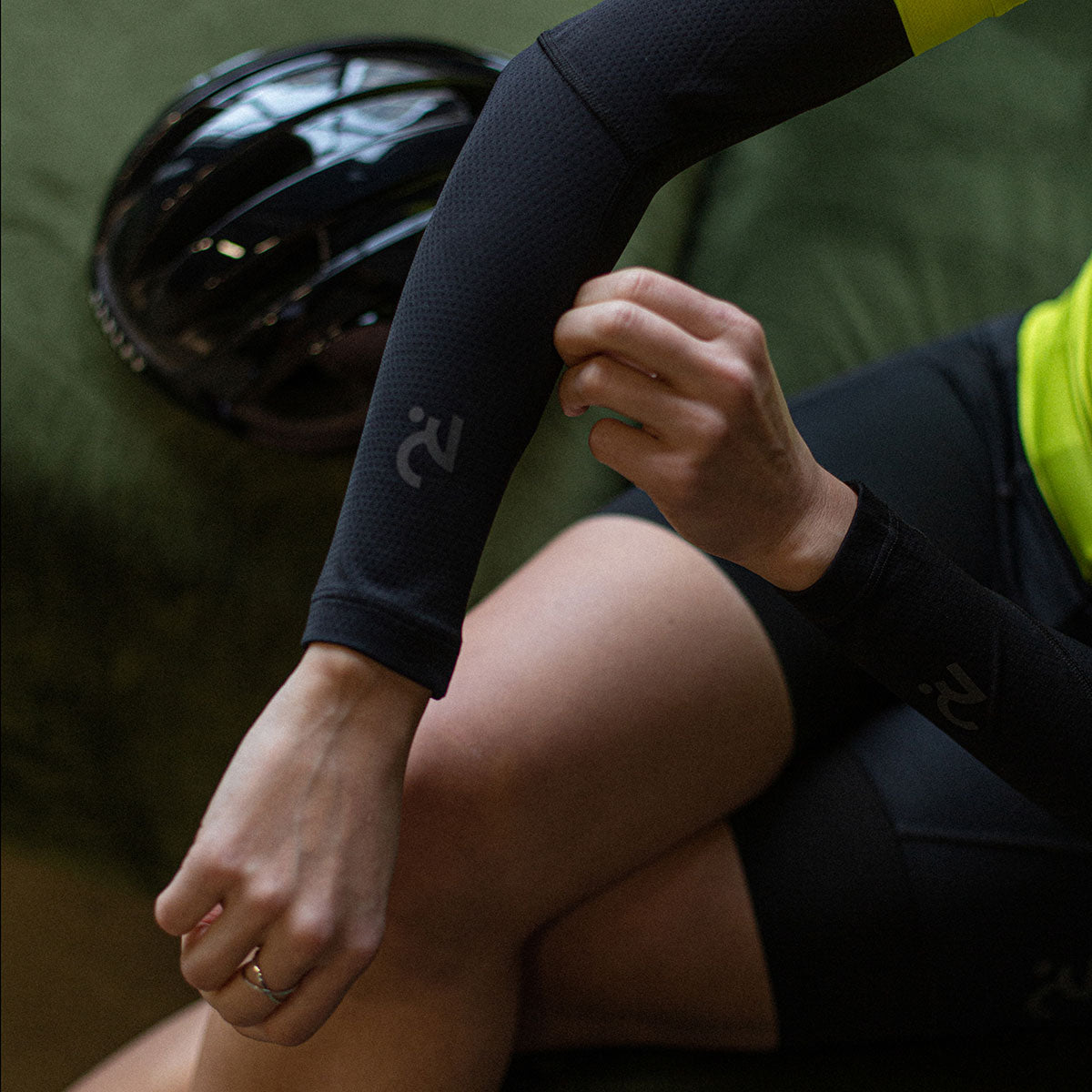
Arm warmers and a long sleeve jersey are two ways to solve the same problem — cold arms — and the right one depends on how changeable your ride is. Arm warmers pull over a short sleeve jersey and can be stripped off and pocketed mid-ride, so they win when the day will warm up or the temperature will swing. A long sleeve jersey builds the coverage in, so it wins when it's cold from start to finish. Above ~16°C neither is needed; from 8–16°C arm warmers are usually the pick; below 8°C a long sleeve (or a base layer plus warmers) pulls ahead. Here's how to choose.
The short answer
Arm warmers are the flexible option: a pair of sleeves that turn your existing short sleeve jersey into cold-weather kit, then disappear into a pocket the moment you're warm. A long sleeve jersey is the committed option: continuous coverage, often a brushed inner and a wind-resistant front, in one piece you don't take off. Choose arm warmers for changeable days you want to manage on the move, and a long sleeve when the cold is steady and you'd rather not fiddle.
How they compare
- Flexibility: arm warmers can be removed mid-ride; a long sleeve can't (without stopping to change).
- Warmth: a long sleeve is warmer at the extremes — continuous coverage, thermal fabric, no gap. Arm warmers close most of that gap in their range, and fleece versions add real warmth.
- Packability: arm warmers fold into a jersey pocket; a long sleeve you're committed to for the ride.
- Range covered: a short sleeve jersey plus arm warmers spans roughly 8 to 18°C in one kit; a long sleeve is focused on the cold end.
When arm warmers win
Reach for arm warmers when the day will change or you want options.
- Cold starts that warm up: on for the first hour, pocketed once your core heats up and the sun climbs.
- Shoulder-season rides (8–16°C): the classic arm-warmer window.
- Racing and fast group rides: strip them when the pace lifts and your arms are warm.
- Travel and minimal kit: a short sleeve jersey plus warmers covers far more range than packing a separate long sleeve.
Arm warmers also pair with a gilet to cover arms and core independently — flexible where a single jersey isn't.
When a long sleeve jersey wins
A long sleeve jersey is the better tool when the cold is consistent.
- Steady cold below ~8°C: continuous coverage and a thermal inner beat a bare short sleeve with warmers.
- Wind and long descents in real cold: no arm-warmer junction to seal, no gripper to slip.
- Simplicity: a fixed setup you pull on and forget, with nothing to manage mid-ride.
- Deep winter, over a base layer: the foundation of a cold-weather kit.
The standard vs fleece question
If you go the arm-warmer route, there are two kinds. Standard arm warmers are light and highly packable, made for roughly 10–16°C and changeable conditions. Fleece arm warmers have a brushed inner for extra warmth in the 4–10°C range — closer to a long sleeve's warmth, though less packable. Many riders own both: standard for spring and autumn, fleece for cold mornings. Between fleece warmers and a long sleeve, the deciding factor is again flexibility versus simplicity.
Fit matters more than you'd think
Arm warmers only work if they stay up. Look for a wide silicone gripper at the bicep, a four-way-stretch fabric that follows your arm without bunching at the elbow, and a length that reaches from wrist to just above the bicep. Wear them over the jersey sleeve with a slight overlap so no cold air gets in at the junction. A pair that slips is usually a size too big — the gripper needs light tension to hold.
Which should you buy first?
If you already have a short sleeve jersey, arm warmers are the more efficient purchase: they extend the kit you own across a wide temperature range for very little, and they pocket away when you don't need them. Add a long sleeve jersey when your riding runs into steady, deep cold and you want the warmer, simpler option for those days. Most riders keep both and choose by the forecast.
FAQ
Are arm warmers as warm as a long sleeve jersey? In their range, close — a good pair seals at the bicep and covers the whole arm, and fleece versions add real warmth. Below about 8°C, a long sleeve's continuous coverage and thermal fabric pull ahead.
When should I wear arm warmers? Roughly 8–16°C, and any time the day will warm up. You can add them for a cold start and strip them once you're warm — flexibility a long sleeve can't match.
Do arm warmers slip down? Only if they're the wrong size or the gripper is worn. Worn over the jersey sleeve with a silicone gripper in light tension at the bicep, a well-fitted pair stays put.
Long sleeve jersey or short sleeve plus arm warmers? Long sleeve for steady cold and simplicity; short sleeve plus arm warmers for changeable days and flexibility. The combo covers a wider range; the long sleeve is warmer at the cold end.
Do I still need a base layer? Yes — a base layer helps under either, wicking sweat and adding warmth. It's what lets a short sleeve jersey and arm warmers stretch into colder weather.
The bottom line
Arm warmers for flexibility and changeable days; a long sleeve jersey for steady cold and simplicity. Add a pair of DTR arm warmers to stretch your jersey across the seasons, and reach for a long sleeve when the cold sets in.
—
DTR — performance cycling and triathlon apparel, designed and developed in Ukraine.

Leave a comment
This site is protected by hCaptcha and the hCaptcha Privacy Policy and Terms of Service apply.